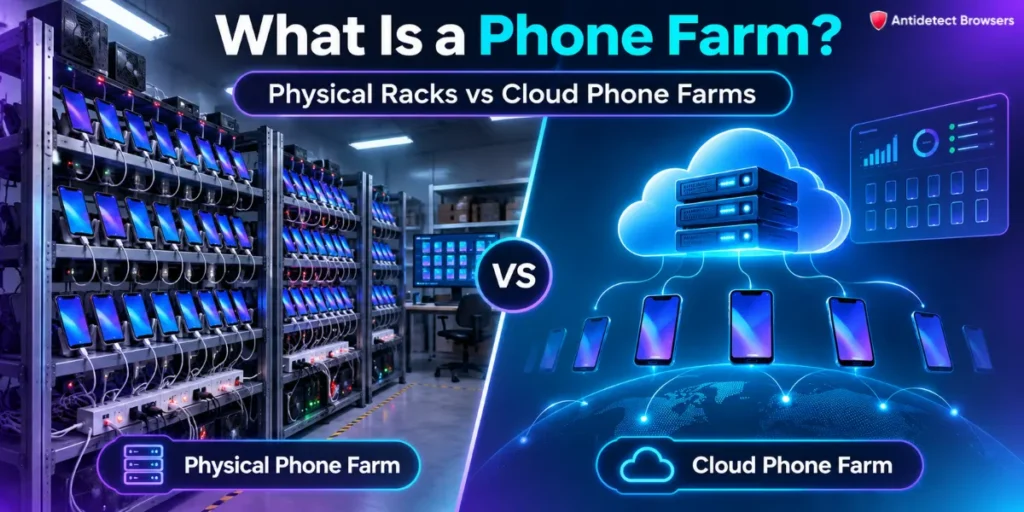
Quick answer: A phone farm is a rack of real phones run from one control system, used for app testing, client accounts and ad checks.
Twenty physical phones cost about $3,704 in hardware plus $313 to $326 a month. Twenty cloud phones at 2 hours a day cost $432 to $598 a month with nothing up front.
What is a Phone Farm?
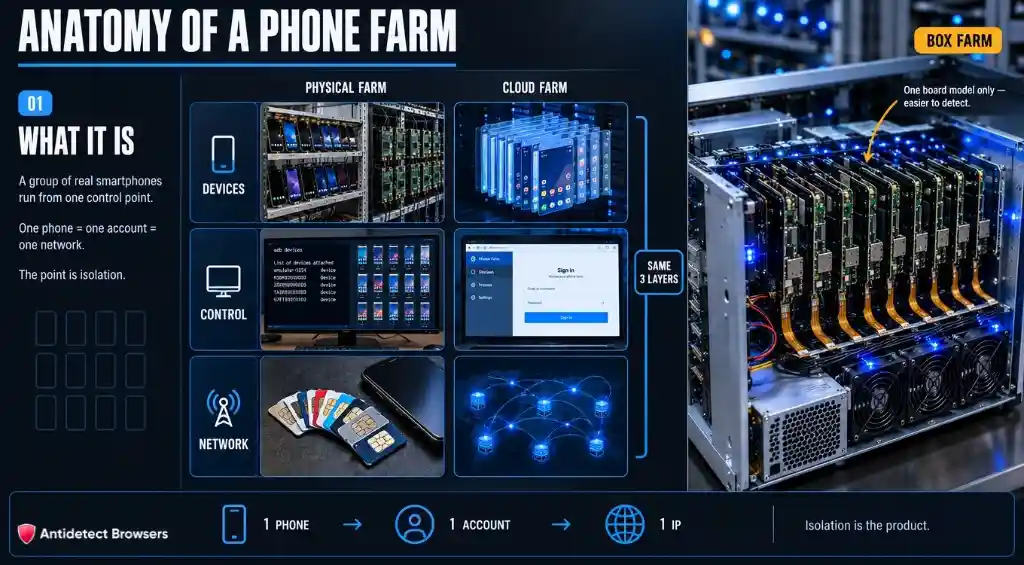
A phone farm is a group of real smartphones, from a handful to thousands, run together from one control point. Each phone usually holds one account or one test session, with its own network connection.
The point is isolation. Platforms link accounts through shared devices and shared IPs, so operators who run many accounts give each one its own phone.
How Does a Phone Farm Work?
Every farm, physical or cloud, has the same three layers.
| Layer | Physical phone farm | Cloud phone farm |
|---|---|---|
| Devices | Retail phones on shelves, or bare boards in a box chassis | Android instances on remote servers |
| Control | A PC running ADB, screen mirroring and group-control software | The vendor's web or desktop dashboard |
| Network | A SIM per phone, or Wi-Fi plus a proxy per phone | A proxy assigned to each cloud phone |
A box phone farm strips phones down to their motherboards and mounts them in one chassis with shared power and fans. It is tidier than a shelf, but it locks you into one board model. That matters for detection.
Who Uses Phone Farms, and For What?
The hardware is neutral. What you run on it decides whether it is normal business or fraud.
Legitimate uses
The uses platforms fight
Fake engagement and ad fraud break every major platform's rules and, in many places, the law. This article does not cover them.
TikTok's Community Guidelines say: “We do not allow the trade of services that attempt to artificially increase engagement.” Google counts clicks from bots and scripted tools as invalid clicks.
In the US, the FTC's final rule bans buying or selling fake social media influence for commercial use.
In the UK, owning a SIM farm without a good reason became an offence on 29 Oct 2026. The law covers devices that use five or more SIMs to call or text.
Most platforms also limit or forbid running multiple accounts. Check each platform's terms before you buy a single phone. Our antidetect browser legality guide covers the basics.
What about a TikTok phone farm?
TikTok allows multiple accounts for authentic creative use, not to deceive or dodge enforcement. It treats bulk-run accounts and unauthorized automation as spam. A phone per real client account, posting that client's content, is the version that holds up.
What Does a Physical Phone Farm Setup Cost?
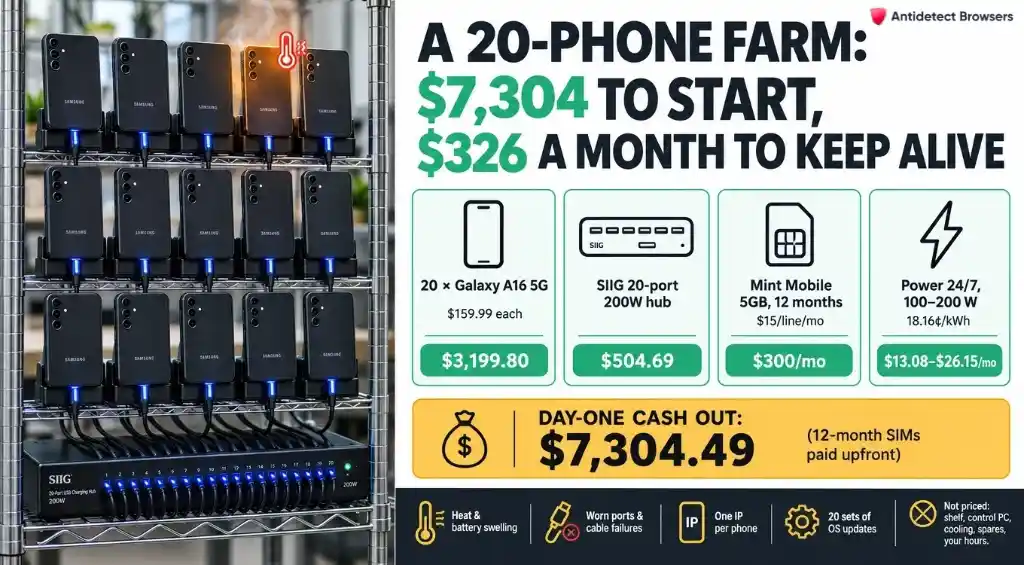
For 20 phones, about $3,704 in hardware, then $313 to $326 a month to keep them online. Here is the build we priced.
| Item | Unit price | Qty | Cost |
|---|---|---|---|
| Samsung Galaxy A16 5G (listed as no-plan device) | $159.99 | 20 | $3,199.80 |
| SIIG 20-port USB charging hub, 200 W | $504.69 | 1 | $504.69 |
| Mint Mobile 5GB SIM, 12-month plan | $15 a month | 20 | $300 a month |
| Power, 24/7 at 100 to 200 W | 18.16 cents per kWh | 72 to 144 kWh a month | $13.08 to $26.15 a month |
Mint bills the 12-month plan up front ($180 a line), so day-one cash is $7,304.49. At the A16's $199.99 list price, hardware rises to $4,504.49. The 100 to 200 W draw is our estimate, capped at the hub's rating.
Not in the table: a shelf, a control PC, cooling, spare phones and your hours.
The pain no price tag shows
How do Platforms Detect Phone Farms?
They look for clusters: many accounts sharing things that separate, real people would not share. Mobile measurement firm Airbridge lists the main signals.
AppsFlyer adds that fraud farms reset device IDs between installs to pose as new users.
What this means for legitimate teams
The same signals can flag an honest agency. Ten client accounts on one office IP, all posting in the same minute from a synchronizer, look like a farm. Make the separation real:
What is an Android Cloud Phone?
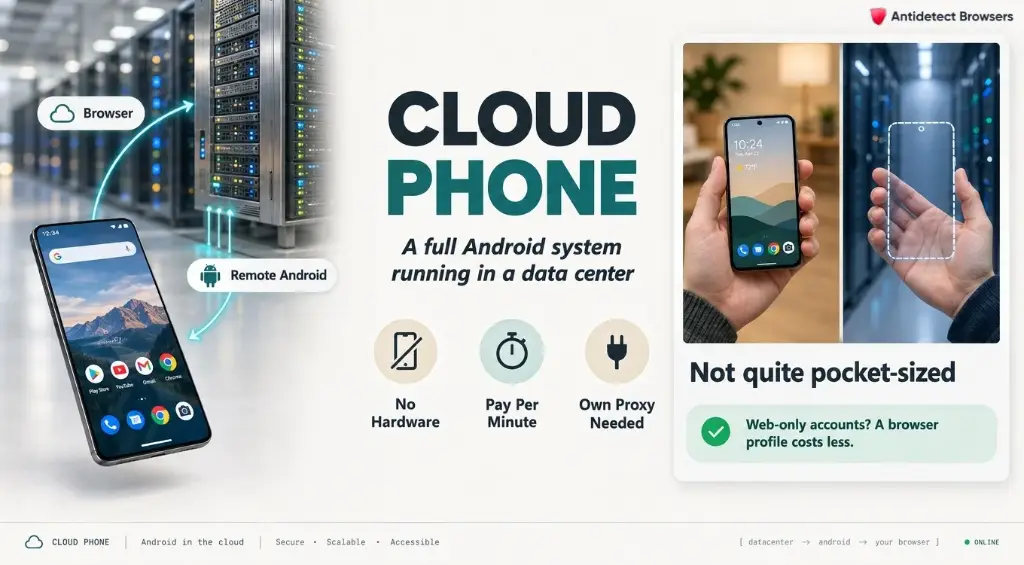
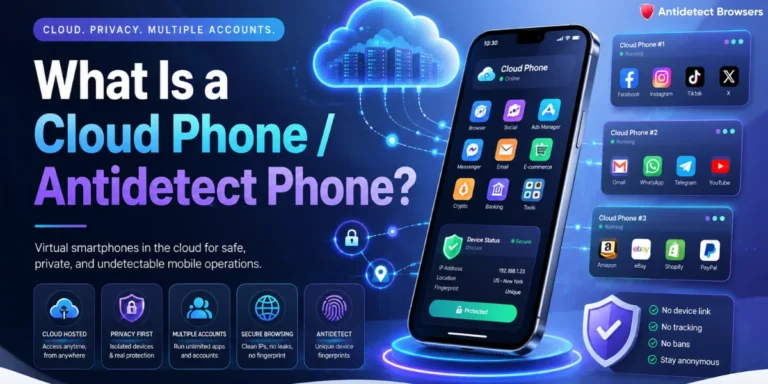
An Android cloud phone is a full Android system on a remote server that you run from a browser or desktop app.
Our cloud phone explainer covers the background. Vendors describe their hardware differently, and we have not verified any of it yet:
Why teams switch: no hardware, and billing by the minute or month. Each cloud phone still needs its own proxy.
The catch: a cloud phone still lives in a data center, and may look less like a pocket phone than a real handset does.
If your accounts work fine on the web, you may not need phones at all. A profile in one of the mobile antidetect browsers costs less.
Cloud Phone vs Phone Farm: What do 20 Phones Cost Per Month?
At 2 hours a day per phone, 20 cloud phones cost $432 to $598 a month. A 20-phone physical farm costs $467 to $481 a month with hardware spread over two years. The totals are close, so upfront cash and labor decide it.
Assumptions (change them and the answer moves):
| Setup (20 phones) | Up front | Light use (2 h a day) | Heavy use (24/7) | Math |
|---|---|---|---|---|
| Physical: Galaxy A16 5G, hub, Mint SIMs | $3,704.49 | $467.43 to $480.50 | $467.43 to $480.50 | $300 SIMs + $13.08 to $26.15 power + $154.35 hardware |
| GeeLark, per minute ($0.007) | $0 | $504.00 | $720.00 (daily cap) | 72,000 × $0.007; cap $1.20 × 30 × 20 |
| GeeLark, monthly rental ($29.90 per phone) | $0 | $598.00 | $598.00 | 20 × $29.90 |
| MoreLogin, per minute ($0.006) | $0 | $432.00 | $900.00 (daily cap) | 72,000 × $0.006; cap $1.50 × 30 × 20 |
| MoreLogin, monthly ($23 to $25 per phone) | $0 | $460 to $500 | $460 to $500 | 20 × $23 to $25 |
| Multilogin, per minute ($0.0073) | $0 | $525.60 | $788.40 [confirm] | 72,000 × $0.0073; 180 billed minutes × $0.0073 × 30 × 20 |
GeeLark's $1.20 daily cap applies to paid subscriptions. Multilogin bills only the first 180 minutes of an uninterrupted session. Its heavy-use figure assumes one session per phone per day, such as a daily restart.
What the math says
Which Cloud Phone Farm Software Should You Use?
GeeLark for all-day phones on a flat rate. MoreLogin for the lowest per-minute price. Multilogin if your team already runs its browser.
| Cloud Phone Provider | Device (vendor's description) | Per minute | Cap or flat rate | Free tier | Our code |
|---|---|---|---|---|---|
| GeeLark | Real Android cloud phones | $0.007 | $1.20 a day (paid plans); $29.90 a month rental | 2 profiles, 1 seat | AFFMAVEN, 20% off paid plans |
| MoreLogin | Android 12 to 15 on ARM servers | $0.006 | $1.50 a day; $23 to $25 per 30 days | 100 minutes, 2 profiles | [code, confirm] |
| Multilogin | Real Android hardware, Android 10 to 16 | $0.0073 (from $0.0067 in bulk) | Bills first 180 minutes of a session | 5 profiles, 30 one-time minutes | BROWSER50, [confirm]% off first billing |
GeeLark: best for all-day phones on a flat rate
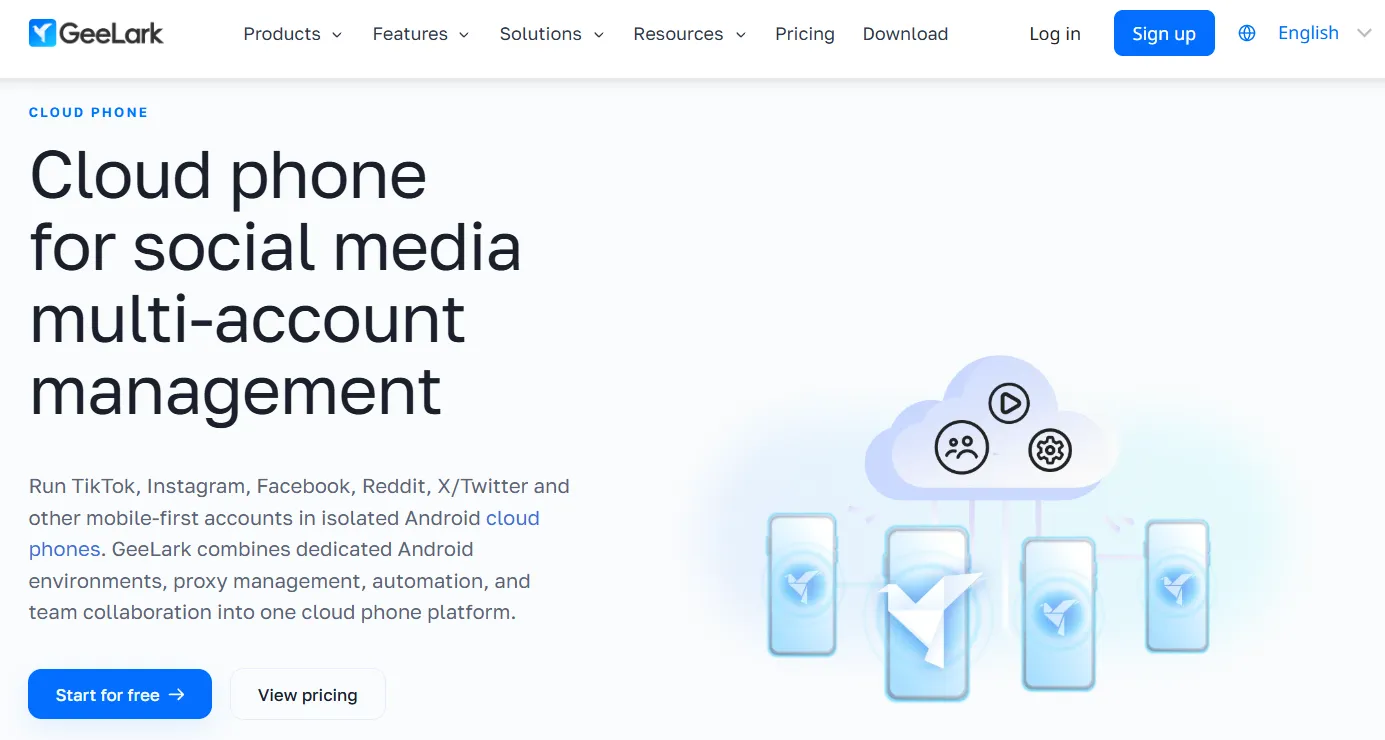
GeeLark is a cloud phone platform for app-based account work, not a browser. It made the list for the $29.90 monthly rental with unlimited use. Tooling covers a synchronizer, RPA, an API and a proxy per phone.
Where it falls short:

GeeLark Coupon Code AFFMAVEN: Get 20% Off Today
exclusive
Save 20% with GeeLark coupon code AFFMAVEN and access unlimited cloud phone rentals, Android automation, and account management tools.
SAVE UP TO 20%
MoreLogin: cheapest per minute on paper
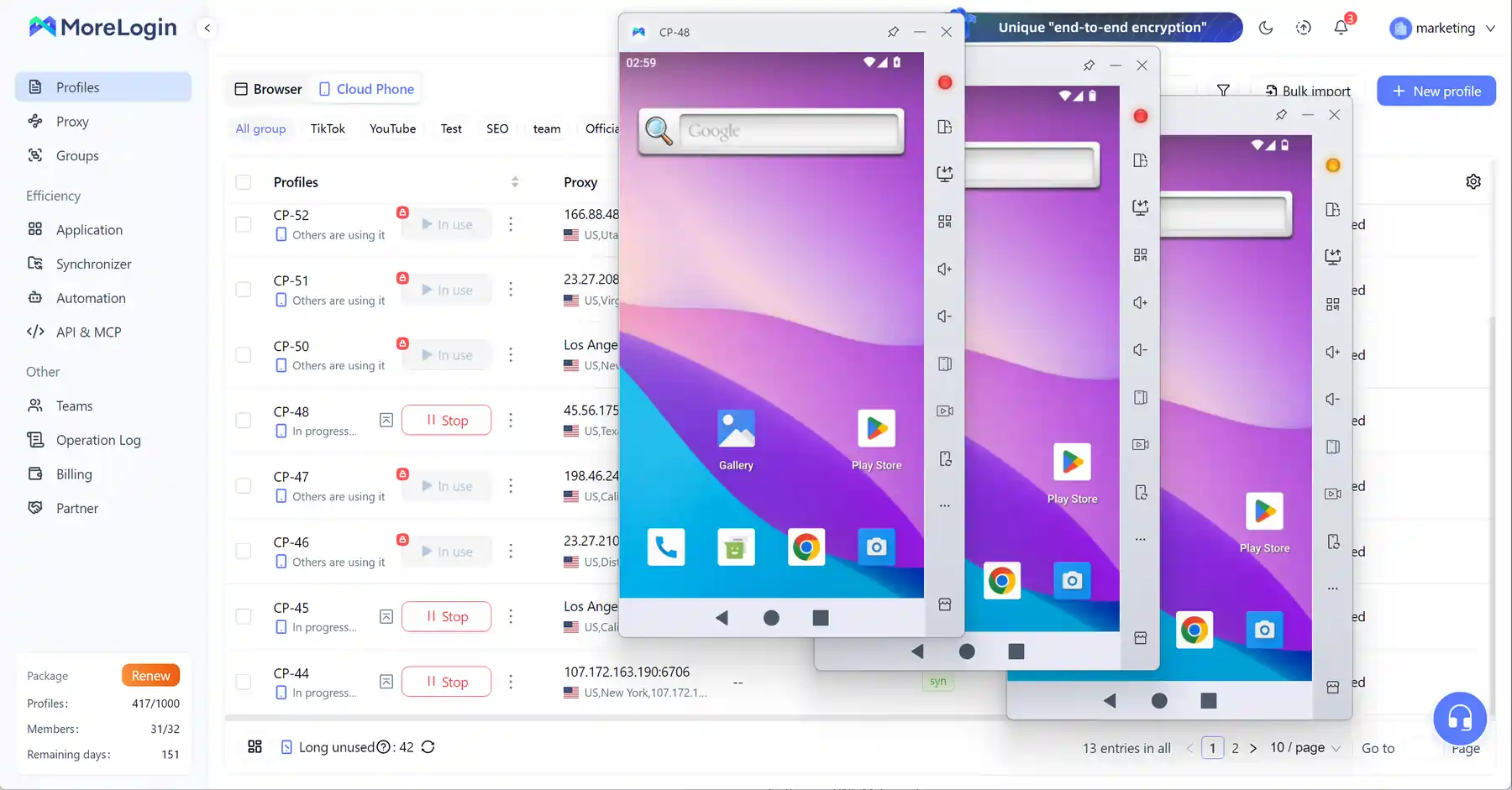
MoreLogin is an antidetect browser vendor that also sells Android cloud phones. It offers no-code RPA with Make, Zapier and n8n hooks, an API with ADB, and batch app installs.
Where it falls short:
MoreLogin Coupon: Save 15% on Cloud Phones
exclusive
Use MoreLogin code AFFINCO for 15% off Android cloud phones, antidetect browser profiles, automation tools, and affordable account management.
Option 2
SAVE UP TO 15%
Multilogin cloud phone: best if you already run Multilogin
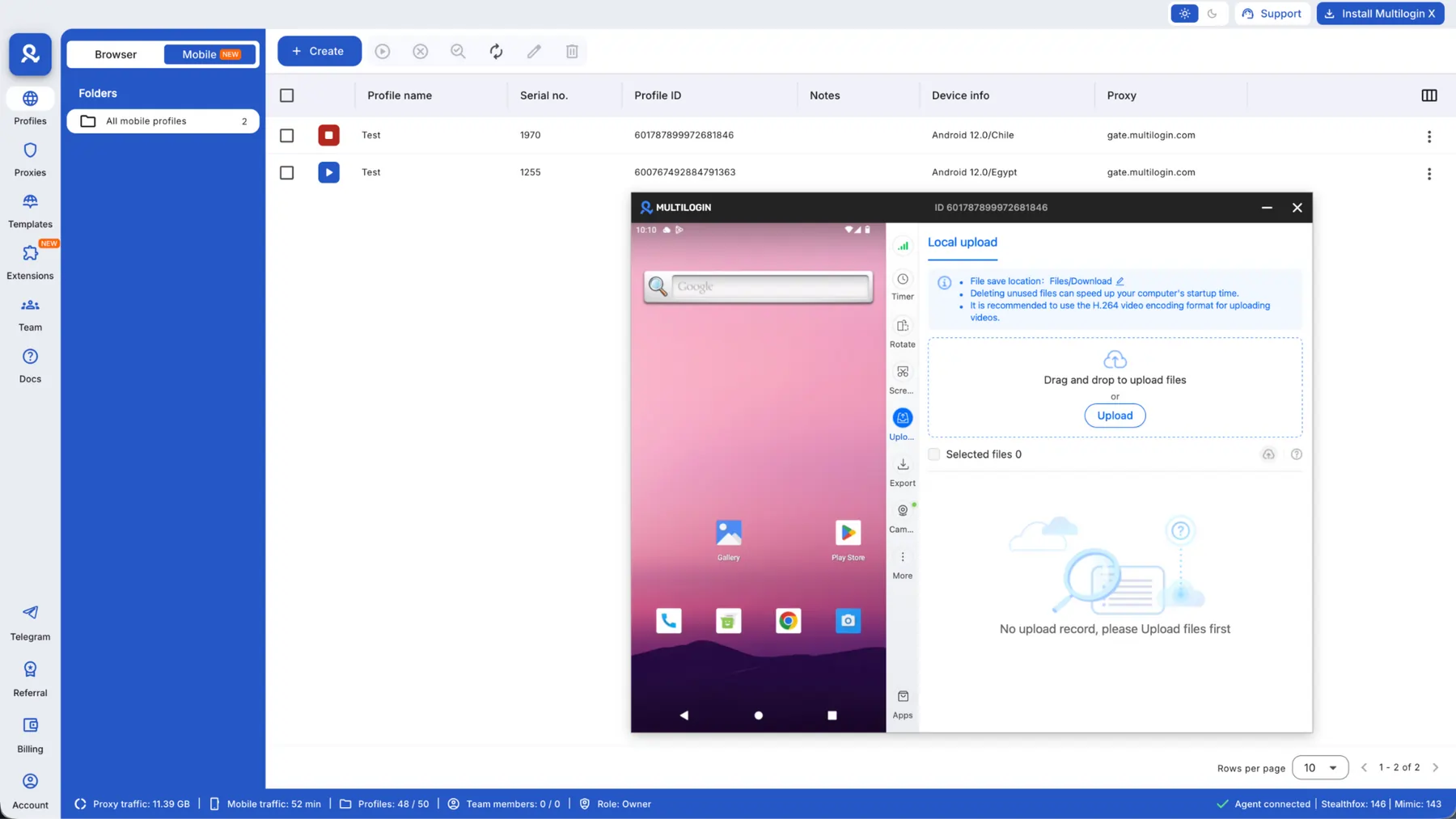
Multilogin puts cloud Android profiles in the same dashboard as its browser profiles. Each gets its own proxy plus ADB and API automation The timer runs only while a phone is active, and unused paid minutes roll over.
Where it falls short:
Multilogin Coupon Code: Grab 50% Off Today
exclusive
Save 50% with Multilogin coupon code AFFMAVEN50 and access cloud phones, Android profiles, proxy management, and browser automation.
SAVE UP TO 50%
How do you Choose Between a Physical and a Cloud Phone Farm?
Pick by hours per day and by what the phones must do.
Go cloud if:
Go physical if:
Phone farm setup: six steps for a cloud farm
Common mistakes
FAQs Related to Phone farm
Is it illegal to run a phone farm?
Owning and running many phones is legal in most places, and app testing labs do it every day. What you run on them is the issue. Fake engagement, click fraud and install fraud break platform rules and can break fraud laws. In the UK, possessing a SIM farm without a good reason has been an offence since 29 Oct 2026.
How does a phone farm work?
Each phone holds one account or test session. A control system sends commands, mirrors screens and runs scripts across all the phones at once. Physical racks use ADB and mirroring tools; cloud phones use the vendor's dashboard. A SIM or proxy per phone gives each one its own network identity, so accounts stay apart.
What is a box phone farm?
A box phone farm is a metal chassis holding many phone motherboards with no screens or batteries. The boards share power, USB control and cooling fans. Sellers pitch boxes as tidier and cooler than shelves of loose phones. The trade-off: you are tied to one board model, and identical models are a pattern fraud tools flag.
Is a cloud phone farm cheaper than a physical one?
Month to month, the two are close. The real gap is cash up front and labor. In our math, 20 cloud phones at 2 hours a day cost $432 to $598 a month before proxies. A 20-phone physical farm costs $467 to $481 a month once $3,704 of hardware is spread over two years.
Can TikTok detect a phone farm?
TikTok does not publish its detection methods. Fraud vendors describe the usual signals: shared IPs, identical device models, synchronized actions and robotic behavior. TikTok's guidelines treat bulk-run accounts and unauthorized automation as spam. One phone per genuine client account, posting that client's own content, is the setup that stays inside the rules.
What software runs a phone farm?
Physical farms use Android Debug Bridge (ADB) plus a mirroring tool such as scrcpy. It is free, open source, and runs on Windows, macOS and Linux. Group-control software then sends one command to many phones. Cloud farms ship with their own dashboards, automation and per-phone proxy settings.
Next step
Compare more vendors in our cloud phone providers ranking. If a flat-rate phone per client sounds right, read the GeeLark review before you buy.