Antidetect browsers are now serious marketing tech, not fringe software. In 2026, brands, affiliates, agencies, e-commerce sellers, SEO teams, and research teams use them to manage accounts, protect browser fingerprints, test ads, and reduce platform risk.
Demand is rising because online activity keeps growing: 6.12 billion people use internet services, and 5.79 billion social media identities are active worldwide in 2026. For marketers, that means more accounts, more checks, and more identity signals.
This AntidetectBrowsers.com market report breaks down current adoption, leading tools, growth drivers, buyer needs, and our 2026 to 2035 forecast with practical calls for media buyers today.
Antidetect Browser Market Snapshot 2026
The antidetect browser market is growing because online platforms now use browser fingerprints, IP signals, cookies, device data, account behaviour, and risk scoring to decide if activity looks real or risky.
Marketers need safer account systems because social, ad, search, e-commerce, and marketplace work now depends on clean browser sessions and stable identity control.
AntidetectBrowsers.com sees 2026 as a shift from “privacy tool” to marketing operations software.
That shift matters because buyers now compare these tools on profiles, proxies, automation, team access, cloud sync, and platform match, not only privacy claims.
What Is an Antidetect Browser?
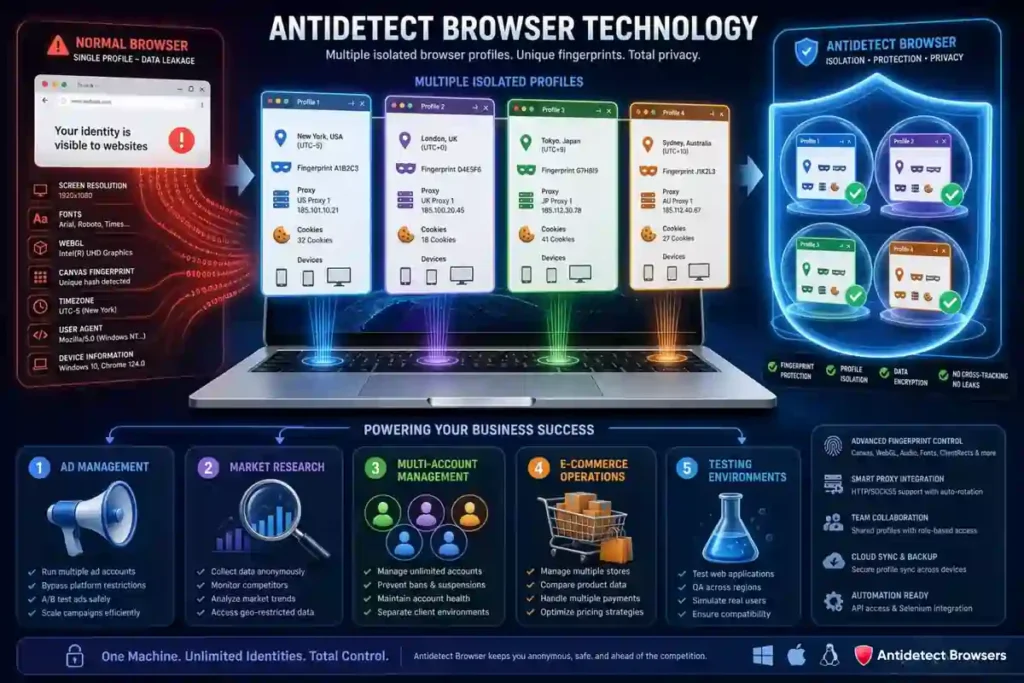
An antidetect browser creates separate browser profiles, and each profile can hold its own fingerprint, cookies, proxy, timezone, extensions, and device setup.
That means one machine can manage many separate working sessions without each account looking like it came from one browser setup.
A normal browser exposes data such as screen size, fonts, WebGL, canvas data, timezone, user agent, and device traits.
An antidetect browser changes or isolates these signals so each profile appears as a different browser environment.
For marketers, browser profile isolation is the main value.
It helps teams avoid account overlap when running ads, testing offers, checking search results, managing shops, or doing research across markets.
Why Market Demand Is Rising
Global social use is huge, and users now visit an average of 6.5 social platforms every month.
That creates more work for agencies managing accounts across Meta, TikTok, Google, YouTube, LinkedIn, marketplaces, and local ad platforms.
People spend 18 hours and 36 minutes per week on social media and online video, which keeps ad spend, content tests, creator work, and account demand high.
For media buyers, more time spent online means more campaigns, more profiles, and more testing pressure.
The second driver is stronger detection.
In 2026, major platforms use machine learning systems that score account behaviour, session consistency, and cross-platform signals.
Old setups like simple VPNs and private tabs no longer solve account safety for teams.
Marketers need browser fingerprint protection, proxy quality, clean cookies, stable login patterns, and process control.
The third driver is affiliate and e-commerce growth.
Affiliate marketing is estimated at about $20.07 billion in 2026, with long-term growth forecast through 2035.
E-commerce sellers, affiliate teams, and paid ad buyers often run many accounts, offers, stores, pixels, pages, and geo tests.
That work makes multi-account management a normal part of daily marketing, not a side task.
Core 2026 Antidetect Browser Statistics
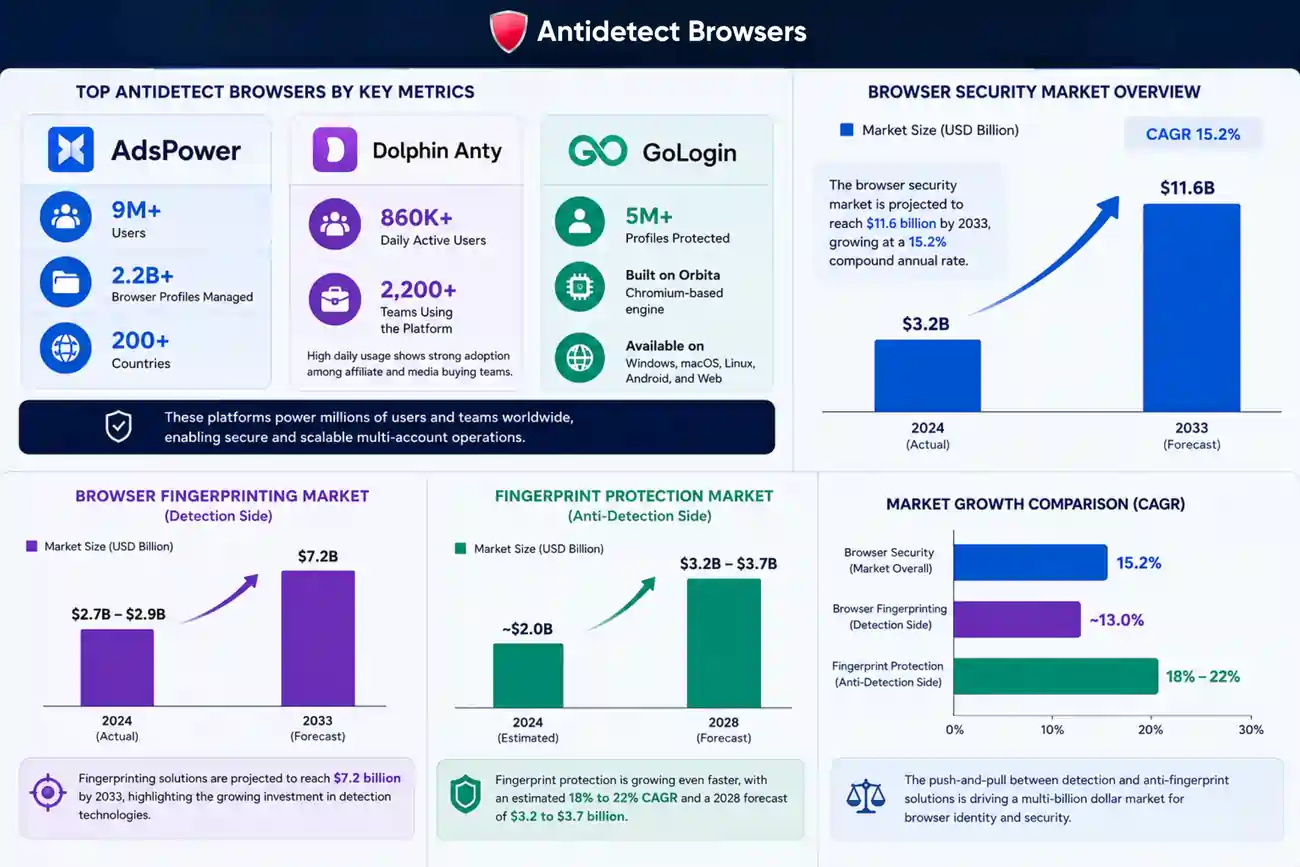
The most visible market statistic in 2026 is scale.
AdsPower crossed 9 million users and has managed more than 2.2 billion browser profiles across 200+ countries.
Dolphin Anty reports 860,000 daily active users and more than 2,200 teams using its platform. That daily usage figure shows how often affiliate and media buying teams now depend on antidetect tools.
GoLogin has protected more than 5 million profiles and runs on its own Chromium-based Orbita engine.
It supports Windows, macOS, Linux, Android, and web access, which makes it relevant for solo users and distributed teams.
The broader browser security market was placed at $3.2 billion in 2024 and is forecast to reach $11.6 billion by 2033 at 15.2% CAGR.
Browser fingerprinting, which is the detection side of this market, was valued around $2.7 billion to $2.9 billion in 2024 and is projected to reach $7.2 billion by 2033.
That points to a direct push-and-pull between detection vendors and anti-fingerprint browser tools.
Fingerprint protection is growing even faster, with estimated growth near 18% to 22% CAGR and a 2028 forecast of $3.2 billion to $3.7 billion.
That growth rate makes identity protection one of the most active sub-markets tied to browser work.
Main Buyer Groups in 2026
Affiliate Marketers
Affiliate marketers remain one of biggest antidetect browser buyer groups. They run offers across networks, social ads, search ads, native ads, push ads, and influencer channels.
Their pain point is speed. They need to test many campaigns without mixing cookies, pixels, and browser signals.
An antidetect browser helps protect account separation. It also helps teams avoid mistakes when moving between campaigns.
Paid Media Teams
Paid media teams use these tools to manage ad accounts, pixels, pages, business managers, and client logins.
A paid ads setup often has many roles. Media buyers, compliance staff, creative testers, and client managers may all need access.
That is why team account management matters so much. It keeps profiles organised and reduces risky manual login sharing.
E-commerce Sellers
E-commerce sellers use profile tools for stores, buyer accounts, support checks, local testing, and marketplace research.
Seller teams often need clean separation between brands. They also need region-based testing for prices, delivery flows, reviews, and product listings.
For marketplace sellers, browser trust can affect daily work. Account mix-ups can be costly.
Social Media Managers
Social media teams handle many profiles across platforms. They may work with brands, creators, local pages, and community accounts.
A normal browser can become messy fast. Cookies, account sessions, device signals, and login history overlap.
Antidetect browsers help keep each brand or client profile separate.
Web Research and QA Teams
Researchers use antidetect browsers for testing search results, ad placements, local pricing, website access, and app flows.
QA teams use them to test user journeys from many device setups. This helps catch issues that a normal browser may miss.
These uses should stay legal and ethical. Marketers must respect platform rules, data privacy laws, and account policies.
Top Antidetect Browsers In 2026
Below is AntidetectBrowsers.com’s market view for leading tools in 2026.
Rank depends on use case, team size, profile volume, automation need, and budget.
| Antidetect Browser | 2026 market signal | Marketer value |
|---|---|---|
| AdsPower | 9 million+ users, 2.2 billion+ profiles managed, 200+ countries | Strong option for bulk browser profile management, team workflows, and no-code automation. |
| Multilogin | Cloud-based use, team collaboration, and fingerprint control | Useful where profile quality, team roles, and controlled access matter. |
| Dolphin Anty | 860,000 daily active users and 2,200+ teams | Built around fast profile handling for campaign teams and media buyers. |
| MoreLogin | Linked with cloud phone demand and mobile-first platform use in 2026 | A practical pick for teams that need lower entry cost and mobile account work. |
| GoLogin | 5 million+ protected profiles and Orbita Chromium engine | Good for cloud browser profile sync, built-in proxy use, and multi-device access. |
| Incogniton | Free plan, browser fingerprinting, and team management | Suitable for profile grouping, proxy setup, and mid-level account teams. |
| Kameleo | Mobile and desktop support, automation, and local profiles | Strong fit where mobile fingerprint checks and local storage control matter. |
| Octo Browser | Automation and API integration in 2026 browser roundups | Useful for technical teams that need fast profile creation and API-led workflows. |
| 1Browser | Proxy browsing and built-in free proxies | Works for users who want proxy access linked with browser control. |
Get
20% off
Scale campaigns effortlessly using bulk profiles, proxies, automation, and secure browsing trusted by millions of performance marketers.
AdsPower
Exclusive
AdsPower leads by user count. It crossed 9 million users and more than 2.2 billion profiles by 2026.
Its strength is scale. Large teams like bulk profile creation, proxy setup, RPA features, and low entry cost.
For marketers, AdsPower fits daily account work. It is often used by e-commerce sellers, ad teams, affiliate buyers, and social managers.
Get
50% off
with Code
Protect high-value accounts using Multilogin fingerprint masking, cloud phones, and proxies. Apply AFFMAVEN50 for instant 50% Off.
Multilogin
Exclusive
Multilogin is one of oldest names in antidetect browsers. It fits teams that need higher control over browser identity and account separation.
It is often used by agencies and enterprise-style teams. These teams care about profile quality, team roles, and stable fingerprints.
Multilogin can cost more than low-price tools. Yet many advanced buyers pay for stability and a long market record.
Get
20% off
with Code
Unlock faster browser automation workflows with Dolphin Anty Coupon Code AFFBYTE20 and instantly claim 20% Off today.
Dolphin Anty
Exclusive
Dolphin Anty is built around affiliate marketing and traffic arbitrage. It reports 860,000 daily users and more than 2,200 teams.
Its appeal comes from speed. Media buyers need fast profile setup, shared access, tags, notes, proxy checks, and campaign workflows.
Dolphin Anty is a strong fit for teams that live inside paid social and CPA campaigns.
Get
15% off
with Code
Unlock MoreLogin with AFFMAVEN and manage browser profiles, proxies, ad accounts, and CPA campaigns more efficiently today.
MoreLogin
Exclusive
MoreLogin focuses on account protection, social media management, e-commerce, crypto, and affiliate use. It is reported to protect more than 5 million accounts.
Its low starting price makes it attractive for small teams. Cloud phone features also make it useful for mobile-led account tasks.
MoreLogin should grow well as short-form video, social commerce, and mobile-first logins keep rising.
Get
50% off
Boost anonymous browsing, manage multiple accounts, and bypass tracking effortlessly with GoLogin’s advanced antidetect browser technology now.
GoLogin
Exclusive
GoLogin is popular with users who want cloud profiles and easy setup. It has more than 5 million protected profiles and runs on its own Orbita browser engine.
It supports major operating systems and web access. That makes it useful for remote teams and solo marketers.
GoLogin is often picked by users moving from simple proxies to a full browser fingerprinting tool.
Get
40% off
Grab Incogniton 40% discount for secure browser profiles, proxy management, multi-account automation, and affiliate marketing success today.
Incogniton
Exclusive
Incogniton is used for browser profile control, proxy links, and team tasks. It is often listed among 2026 antidetect tools for affiliate managers and small teams.
Its free plan and lower starting price make it easy to test. That matters for new teams building the first multi-account setup.
Incogniton fits users who want simple profile management without paying for enterprise-level features.
Pricing Signals In 2026
Price matters because new buyers often start small, then scale profiles after revenue begins.
Low-cost plans help freelancers and small affiliate teams test antidetect browser software before they pay for team seats.
| Anti-detect Browsers | Entry Price Signal | Positioning Note |
|---|---|---|
| Multilogin | €5.85/month | Premium browser identity control with team use. |
| GoLogin | $4/month | Beginner-friendly pricing with multi-platform access. |
| AdsPower | $7.20 per month | Low entry point for profile-heavy users. |
| Incogniton | $11.99 per month | Accessible plan for team and profile work. |
| Kameleo | €45 per month | Mobile and desktop support for technical users. |
Pricing alone should not decide tool choice.
Marketers should compare fingerprint quality, browser kernel updates, proxy support, profile limits, team control, and automation before picking a plan.
A low-cost tool may work well for testing.
A higher-priced tool may be better if account loss, ad account bans, or client access risk costs more than software fees.
Feature Trends Marketers Should Watch
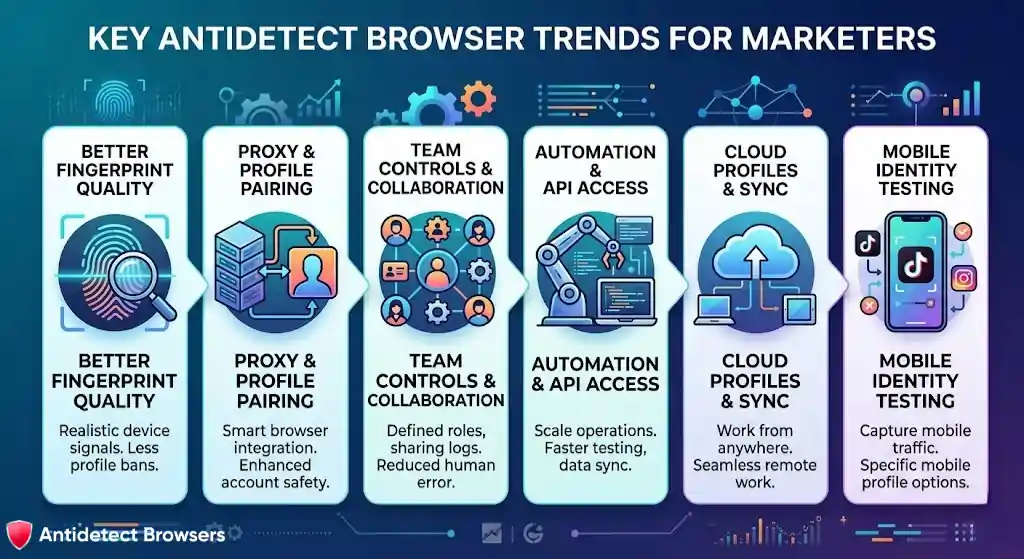
Better Fingerprint Quality
Fingerprint quality is now the main reason to buy. Cheap profile creation is not enough.
Marketers need real-looking device signals. They also need consistency between IP location, time zone, browser language, fonts, and device type.
Poor fingerprint setup can create account risk. Good setup can reduce avoidable flags.
Proxy and Profile Pairing
Proxy quality remains a core part of account safety. But proxy quality alone cannot solve all tracking.
A strong setup pairs proxy, profile fingerprint, cookies, account age, and behaviour.
This is why proxy browser integration is now a must-have feature.
Team Controls
Agencies need roles, notes, tags, profile sharing, logs, and safe access.
Without team controls, staff may share passwords, reuse devices, or open accounts in wrong profiles.
Better controls reduce human error. They also make client work easier to track.
Automation and API Access
Many teams now want automation. Common tasks include opening profiles, checking pages, running QA steps, filling test forms, and tracking page states.
API access is more important for larger teams. It helps connect profiles with internal tools, proxy systems, and reporting.
Automation will likely become a major buying reason in 2027.
Cloud Profiles
Cloud profiles help remote teams work from different locations. They also reduce risk when staff change devices.
GoLogin, AdsPower, and many other vendors now push cloud syncing as a core feature.nodemaven+1
Cloud use will keep rising because agencies hire remote media buyers, assistants, and QA staff across regions.
Mobile Identity Testing
Mobile traffic keeps rising across social, affiliate, e-commerce, and creator marketing.
MoreLogin’s cloud phone feature shows where market demand is going. Mobile-specific profile work is becoming more important for TikTok, Instagram, marketplace apps, and app-based funnels.
Expect more vendors to add stronger mobile profile options.
2026 Use Cases by Marketing Role
Different teams buy antidetect browsers for different reasons.
| Role | Main Use Case | Most Needed Features |
|---|---|---|
| Affiliate buyer | Run paid traffic accounts and offer tests | Fast profiles, tags, proxies, account notes |
| E-commerce seller | Manage stores, support accounts, and regional tests | Profile groups, cookies, proxy match, team access |
| Social media manager | Handle client accounts and brand pages | Profile isolation, easy login storage, safe sharing |
| SEO specialist | Check local SERPs and research accounts | Location control, stable cookies, clean profiles |
| Agency owner | Manage many client logins | Roles, logs, billing, profile permissions |
| QA tester | Test user flows on many browser setups | Device fingerprints, repeatable profiles, automation |
| Data researcher | Collect public web signals within rules | Session control, IP fit, clean browser states |
A marketer should not choose a browser only by price. The right choice depends on account volume, risk level, team size, and workflow.
For one-person use, free plans may work. For agency use, profile sharing and logs matter more.
For high-value accounts, fingerprint quality and proxy fit should come before saving a small monthly fee.
Regional Growth in 2026
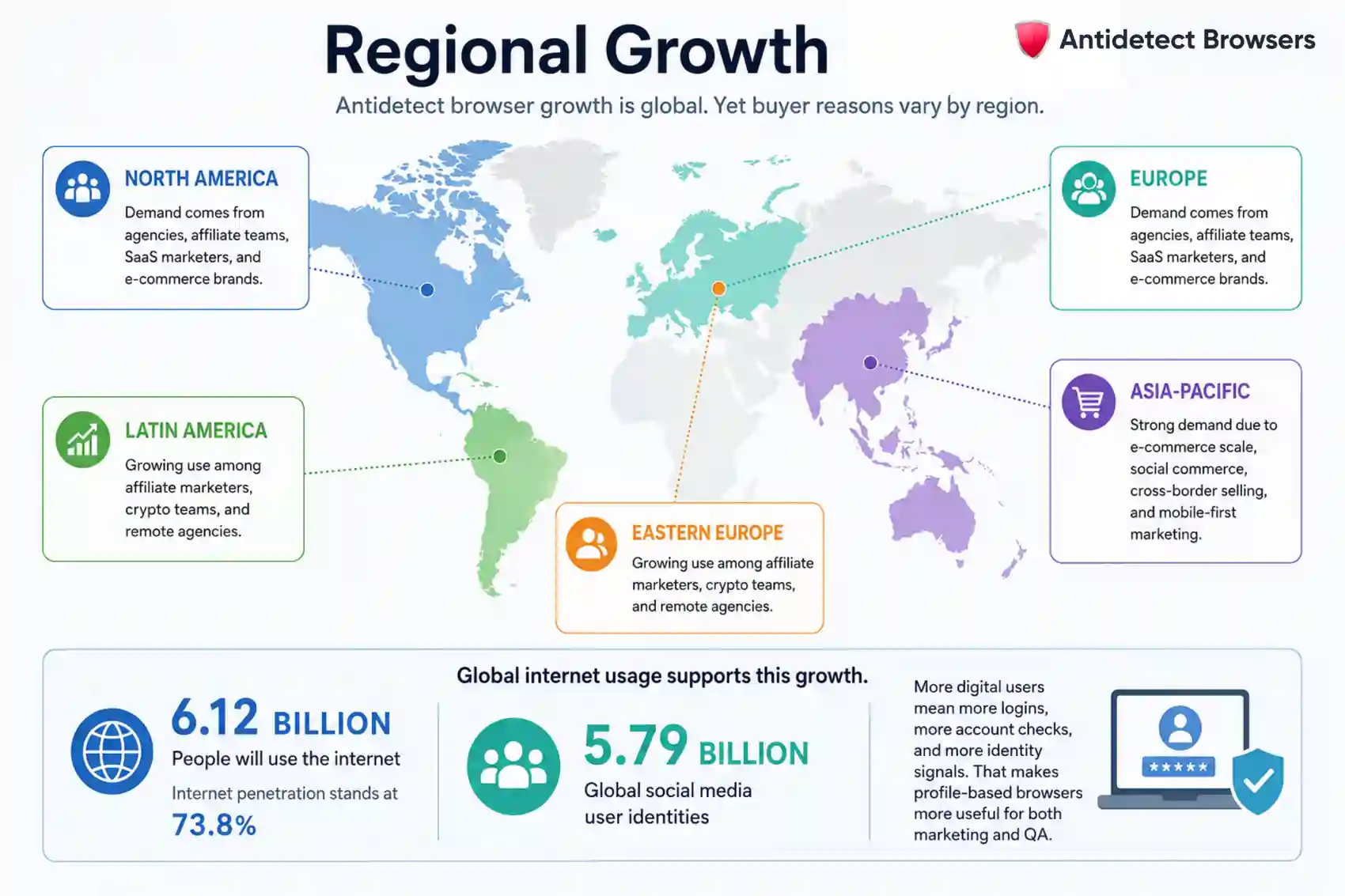
Antidetect browser growth is global. Yet buyer reasons vary by region.
North America and Europe often show demand from agencies, affiliate teams, SaaS marketers, and e-commerce brands.
Asia-Pacific demand is strong because of e-commerce scale, social commerce, cross-border selling, and mobile-first marketing.
Latin America and Eastern Europe show growing use among affiliate marketers, crypto teams, and remote agencies.
Global internet usage supports this growth. In 2026, 6.12 billion people will use the internet, and internet penetration stands at 73.8%.
Social media is another growth base. Global social media user identities reached 5.79 billion in 2026.
More digital users mean more logins, more account checks, and more identity signals. That makes profile-based browsers more useful for both marketing and QA.
Key Growth Drivers For 2026
First, browser fingerprinting keeps growing. The browser fingerprinting market is projected to reach $7.2 billion by 2033, which means tracking systems will keep getting more advanced.
Second, social and ad platforms have more account signals to read. With 94.7% of internet users using social media each month, social account activity offers huge data pools for risk checks.
Third, Chrome share keep profile quality under pressure. Chrome holds 68.02% of global browser share in 2026, so antidetect tools must keep Chromium kernels fresh and believable.
Fourth, teams want automation. Marketers use antidetect browsers for multiple ad accounts, geo-targeted ads, affiliate offers, e-commerce work, web scraping, research, and SEO testing.
Fifth, affiliate infrastructure keeps gaining value. Affiliate platform market size is estimated at $23.84 billion in 2026, while full affiliate marketing market size is about $20.07 billion in 2026.
Technology Trends Shaping 2026
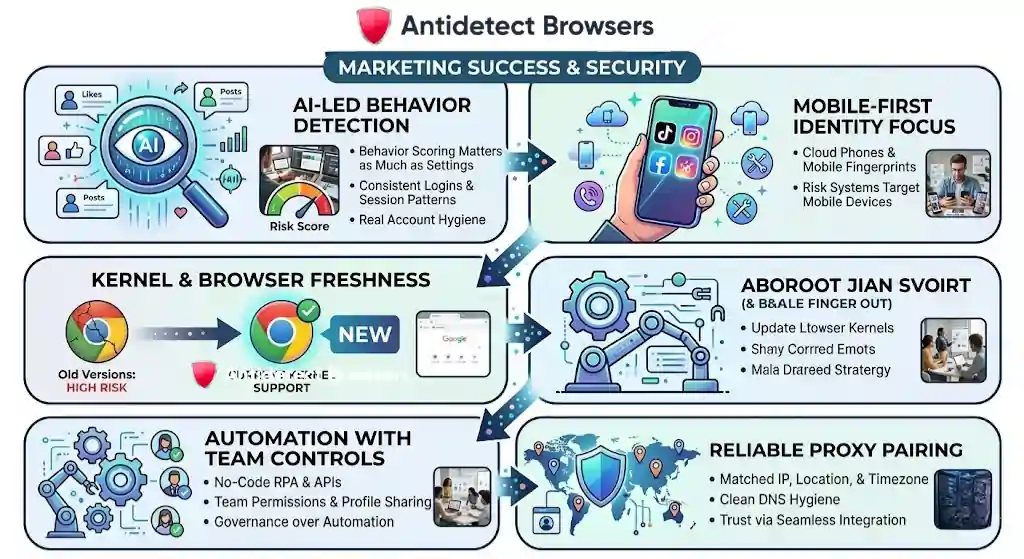
AI-led Detection
Large platforms now score accounts using behaviour, session consistency, and cross-platform signals, not only static fingerprint data.
That means behaviour-based risk scoring matters as much as profile settings.
Marketers need steady login times, clean proxies, natural session patterns, and real account hygiene.
Mobile Identity
TikTok and Instagram have mobile-first risk systems, so cloud phones and mobile fingerprint tools are becoming more important.
Kernel Freshness
AdsPower added Chrome 144 kernel support in early 2026, and old Chrome versions can raise risk on advanced platforms.
Automation with Controls
No-code RPA, APIs, team permissions, and profile sharing are becoming normal features for affiliate marketing automation teams.
Proxy Pairing
A browser profile without a matched proxy can still look risky, so IP quality, location match, timezone match, and DNS hygiene matter.
Browser Market Share And Fingerprint Quality
The browser share data matters because antidetect browsers must copy real market behaviour.
Chrome holds 68.02% global browser share, Safari holds 17.04%, Edge holds 5.53%, Firefox holds 2.26%, Samsung Internet holds 1.99%, and Opera holds 1.89% in 2026.
A profile claiming to be a rare setup can work, but common setups often look more natural.
That is why many teams prefer fresh Chrome-based profiles for ads, affiliate work, and marketplace tasks.
Safari support also matters for mobile and Mac-style testing.
With Safari holding 17.04% global share, Apple-like browser patterns are still important for brands that test iOS traffic and premium user segments.
Firefox has a lower share, but it still matters for privacy and testing.
Some antidetect tools support Firefox-style engines because varied browser types can help QA, research, and platform checks.
Affiliate Marketing Link
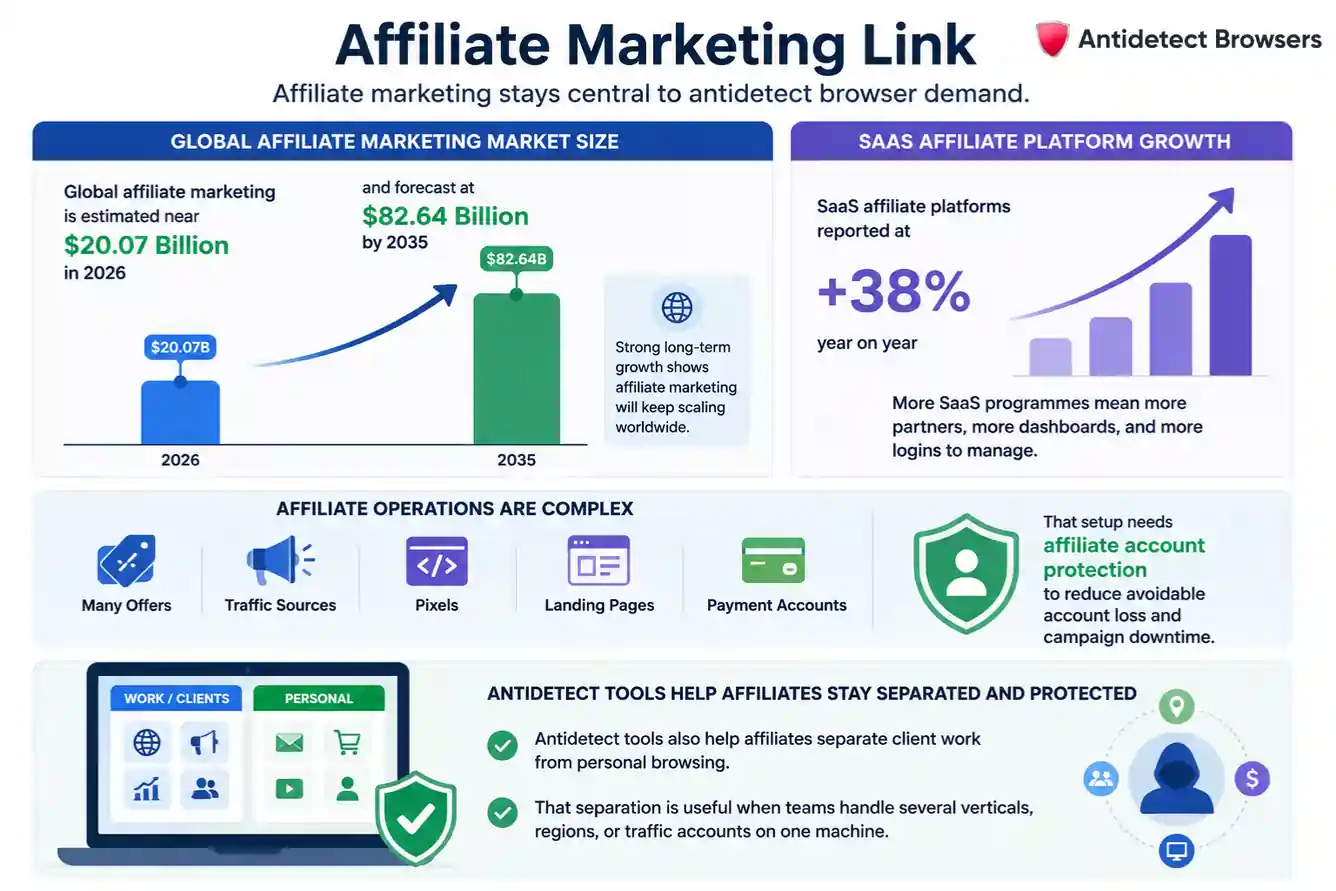
Affiliate marketing stays central to antidetect browser demand.
Global affiliate marketing is estimated near $20.07 billion in 2026 and forecast at $82.64 billion by 2035.
Affiliate teams often handle many offers, traffic sources, pixels, landing pages, and payment accounts.
That setup needs affiliate account protection to reduce avoidable account loss and campaign downtime.
SaaS affiliate platform growth is also strong, with SaaS affiliate platforms reported at +38% year on year.
More SaaS programmes mean more partners, more dashboards, and more logins to manage.
Antidetect tools also help affiliates separate client work from personal browsing.
That separation is useful when teams handle several verticals, regions, or traffic accounts on one machine.
Social Media Agency Demand
Social teams manage client pages, creator accounts, ad accounts, pixels, inboxes, and test profiles.
With 5.79 billion social media identities worldwide in 2026, social work has become one of the largest account management tasks online.
The typical user visits 6.5 social platforms each month.
That behaviour pushes brands to run campaigns across several channels, which creates more operational pressure.
Agencies need social media account management tools that reduce login overlap.
A shared office browser or mixed cookie profile can create avoidable risk.
Antidetect browsers also help teams assign accounts to staff.
Role control, profile sharing, and activity logs are now key buying points for agencies.
Buying Checklist For Marketers
Choose based on outcome, not hype.
A good antidetect browser should match budget, account volume, campaign type, proxy plan, staff skill, and platform risk.
Use this checklist before paying:
A beginner may pick a lower-cost tool with simple profile creation.
A large team should care more about team browser profile control, logs, account access, and support speed.
AntidetectBrowsers.com 2026 Forecast
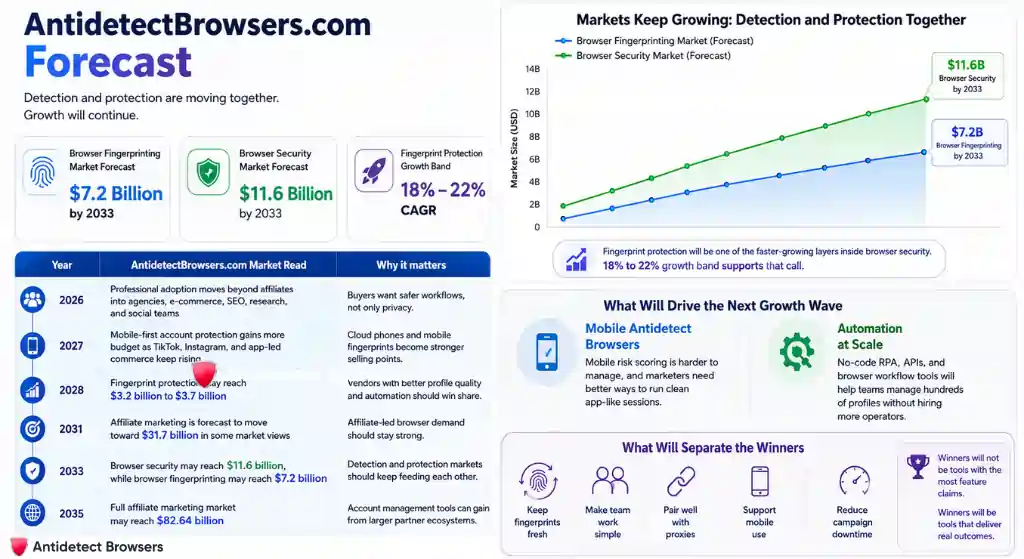
AntidetectBrowsers.com expects the market to keep growing through 2035 because detection and protection are moving together.
Browser fingerprinting is forecast to reach $7.2 billion by 2033, while browser security is forecast to reach $11.6 billion by 2033.
Our view is that browser fingerprint protection will be one of the faster-growing layers inside browser security.
A 18% to 22% growth band for fingerprint protection supports that call.
We think winners will not be tools with the most feature claims.
Winners will be tools that keep fingerprints fresh, make team work simple, pair well with proxies, support mobile use, and reduce campaign downtime.
The next growth wave will come from mobile antidetect browser tools.
Mobile risk scoring is harder to manage, and marketers need better ways to run clean app-like sessions.
Another growth wave will come from automation.
No-code RPA, APIs, and browser workflow tools will help teams manage hundreds of profiles without hiring more operators..
Best Tool By Marketing Need
No single antidetect browser is best for every team.
The right pick depends on account count, traffic source, risk level, and staff skill.
| Marketing need | Strong option | Reason |
|---|---|---|
| High-volume e-commerce profiles | AdsPower | Very large user base and 2.2 billion+ profiles managed. |
| Affiliate and CPA media buying | Dolphin Anty | 860,000 daily active users and affiliate-focused team demand. |
| Beginner-friendly multi-account work | GoLogin | 5 million+ protected profiles and broad platform support. |
| Enterprise-style team control | Multilogin | Cloud-based, team collaboration, and fingerprint control signals. |
| Lower-cost team entry | Incogniton | $13.99 monthly starting price and team management signals. |
| Mobile and desktop testing | Kameleo | Mobile and desktop support with automation and local profiles. |
| Automation-heavy workflows | Octo Browser | Ranked for automation and API integration in 2026 lists. |
| Mobile-first social workflows | MoreLogin | Linked with mobile-first and cloud phone demand in 2026. |
For most marketers, start with ten to twenty clean profiles.
Track login success, ad account health, page access, proxy quality, and staff feedback before scaling.
For agencies, choose a tool with team permissions from day one.
Account access problems become harder once many clients and staff use one workspace.
Final Take
Antidetect browser demand in 2026 is being pushed by social media scale, affiliate marketing growth, e-commerce account work, and stronger platform detection.
Internet usage has reached 6.12 billion people, social media user identities reached 5.79 billion, and affiliate marketing now sits above USD 20 billion, which all support a larger market for profile-based browsing tools.
AntidetectBrowsers.com expects this category to keep growing as marketers need safer account separation, better browser fingerprints, cleaner team workflows, and more automation.
The next winners will be tools that combine realistic profiles, strong team control, proxy fit, mobile support, and clear pricing.
Sources
- DataReportal: Digital 2026 Mid-Year Global Update
- DataReportal: Global Social Media Statistics
- AffMaven: Antidetect Browser Market Report 2026
- StatCounter: Browser Market Share Worldwide
- AFFiNCO: Best Antidetect Browsers 2026
- DataHorizzon Research: Browser Fingerprinting Market
- Market Data Forecast Remote Browser Market
- Mordor Intelligence Web Scraping Market Report