Quick answer: Multilogin is a premium antidetect browser and cloud phone platform, built in 2015 by the team that basically named the category. We ran it hard across our own ad accounts for two months, and it held up. Two browser engines, real-user-based fingerprints across 55+ parameters, built-in residential proxies in every plan, and real Android cloud phones put it a step ahead of most rivals on ban resistance.
The trade off is money. There is no free forever plan, only a $2 trial, and proxy plus mobile minute usage stacks on top of your subscription. Paid plans start at $11/mo (or $7.08/mo billed yearly).
Our verdict, 4.4 out of 5. Best for agencies, affiliates and teams running many ad accounts that cannot afford to get linked.
Let us be honest about how most of us found antidetect browsers. Not through a blog. Through a ban.
You open a second Facebook Business Manager. A week later both accounts are gone. You did not break a single rule. Your browser simply handed the platform the same browser fingerprint twice, and the anti-fraud checks did the rest.
That is the problem an antidetect browser solves. It gives every account its own sealed identity, so ten accounts look like ten separate people on ten separate machines.
We have tried nearly every antidetect browser. This Multilogin review is built the hard way: we put it on our own machines, plugged in our own residential proxies, ran live campaigns, and wrote down what actually happened. No sales page rewrite.
Our Verdict on Multilogin
Short version first, for anyone skimming.
| What we checked | Our take |
|---|---|
| Overall rating | 4.8 / 5 |
| Best for | Affiliates, agencies and teams running many ad and social accounts |
| Fingerprint quality | Top tier. Passed the checkers we ran on our profiles |
| Proxies | Included in every plan, and you can still bring your own |
| Cloud phones | Real Android devices, a genuine edge over emulator based rivals |
| Ease of use | Clean for daily account work, coding needed for heavy automation |
| Value | Fair once you scale, pricey feeling if you only run a handful of profiles |
| Free plan | None. A $2 three day trial is the only free-ish way in |
Who we recommend it to: If bans cost you real money, Multilogin earns its price. If you run one or two accounts for fun, it is overkill and a cheaper tool will do.
The Antidetect Browser Market Is Growing Fast (And So Is Detection)
Antidetect browsers used to be an affiliate-only secret. Not anymore.
By 2026 they became standard kit for ad agencies, e-commerce sellers, SMM teams, scrapers, and QA crews. The wider browser-security market sat at $6.41 billion in 2025 and is forecast to grow at a 16.5% CAGR toward roughly $25 billion by 2034, with enterprise browsers climbing near 20% a year.
Here is why demand keeps rising. Platforms got brutally good at catching multi-account users.
Modern anti-fraud checks like DataDome, PerimeterX, and Cloudflare Turnstile now run machine-learning models on your browser fingerprint in real time. They score behaviour, mouse movement, typing cadence, and network traces.
Newer detection goes past canvas and WebGL into WebGPU, audio context, and TLS-level analysis.
So the bar moved. A cheap tool that just strips signals gets flagged, because a blank fingerprint is itself a red flag. That is the exact gap Multilogin targets, and it is why fingerprint quality now matters more than a low sticker price.
Where Multilogin Sits on Detection Quality
Independent reviewers keep sorting the market into tiers. The top tier (Multilogin, Octo Browser, Kameleo) is credited with roughly 90%+ detection bypass rates on hard platforms thanks to real device fingerprints and daily quality checks.
The next tier (AdsPower, GoLogin, Dolphin{anty}) lands around 80 to 90%. Fine for most jobs, riskier on the strict stuff.
Multilogin lives in that top tier. When one flagged account can nuke a whole ad campaign, that extra 10% is the entire game.
What Multilogin Actually Is in 2026
Most people still call it a browser. That undersells what shipped.
Multilogin now runs on the Multilogin X platform. The old Multilogin 6 build was officially retired in 2025, and every legacy user got free migration to X with no extra steps.
X bundles four things into one dashboard, and this stack is the real reason we pay for it.
One login, mobile and web together. No third-party juggling. That combo is rare.
Two Engines: Mimic (Chromium) and Stealthfox (Firefox)
Multilogin gives you two purpose-built stealth browsers, and picking the right one matters.
Running both engines means your accounts do not all share one identical browser signature. That variety alone lowers linkage risk.
One catch we hit: Puppeteer and Playwright automation only work with Mimic. Stealthfox handles Selenium but not the other two yet. Worth knowing before you script anything.
Real Human-Like Fingerprints Across 55+ Parameters
This is the part that earns the price.
Weak tools fake a fingerprint by blanking values or plugging in random noise. Detection setups catch that instantly, because real humans do not have contradictory hardware.
Multilogin builds each identity from real-user data, so canvas, GPU, audio, and fonts all agree with each other the way a genuine device would. Fewer contradictions, fewer flags.
Here are the signals it controls, grouped so it is easy to scan.
| Fingerprint layer | Parameters Multilogin manages |
|---|---|
| Graphics rendering | Canvas hash, WebGL vendor and renderer, WebGPU signals |
| Audio and media | Audio context fingerprint, media devices, codecs |
| Hardware | CPU cores, device memory, screen resolution, colour depth |
| Network and location | WebRTC IP handling, timezone, geolocation, languages |
| Identity strings | User agent, platform, fonts, plugins, client hints |
When we ran fresh profiles through public fingerprint checkers, the values came back consistent and “human”, not the mismatched mess that cheap tools produce. That consistency is the whole point of fingerprint spoofing done right.
Built-In Residential Proxies in Every Plan
Here is a cost most beginners forget. A profile without a matching IP is useless, because platforms link accounts by IP first.
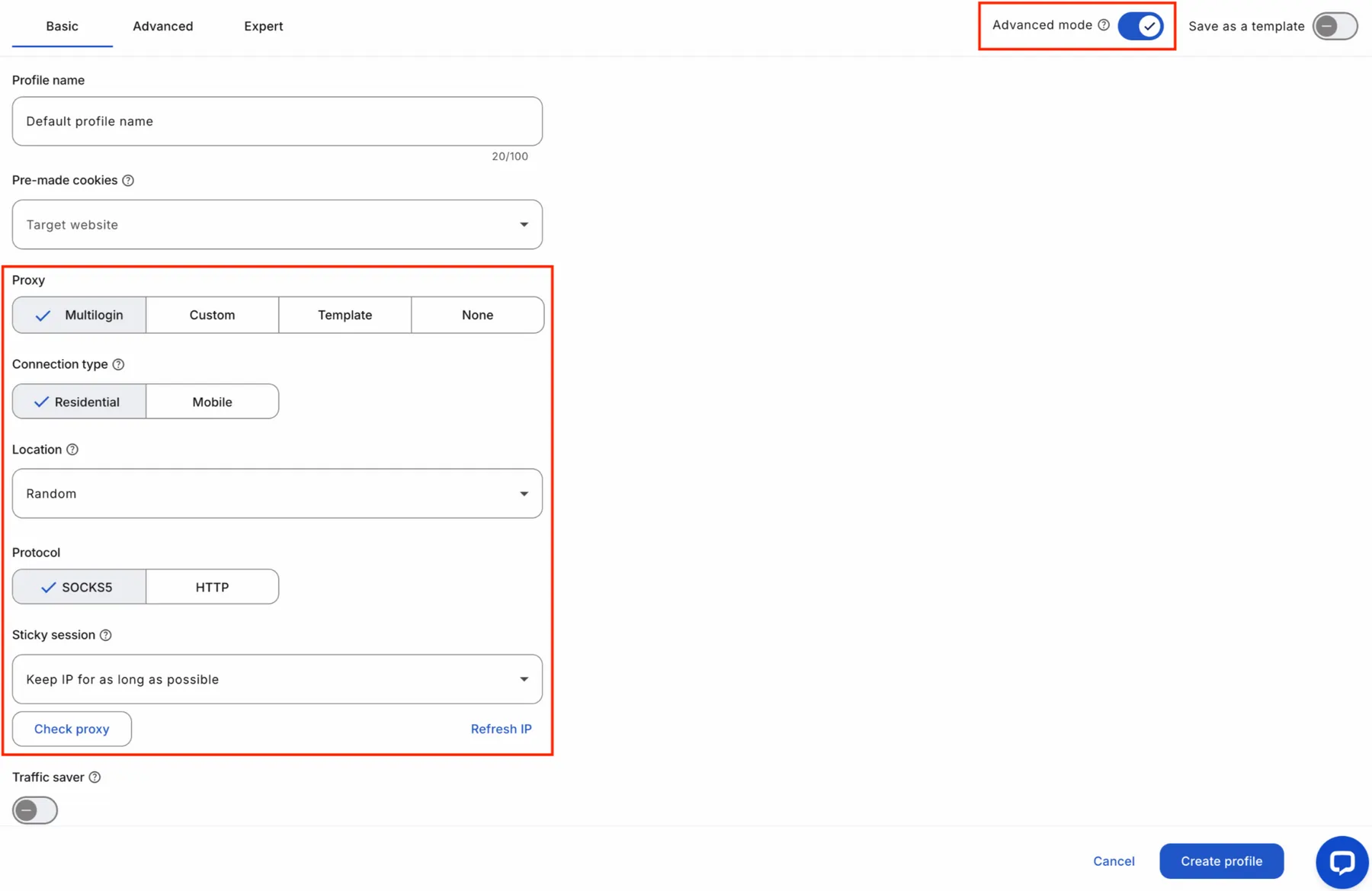
Multilogin bakes residential proxies into every plan. The pool covers 150+ countries and 1,400+ cities, with daily quality checks, all managed inside Proxy Hub.
For affiliates this is huge. A US ad account gets a US residential IP that stays consistent with the profile's timezone and geolocation, so the whole identity lines up.
What we liked in day-to-day use:
Bringing Your Own Proxies
Not locked in. If you already buy proxies, plug them straight in.
Proxy Hub accepts third-party HTTP, HTTPS, and SOCKS5 connections, verifies them, and lets you save reusable proxy templates. We connected our own residential pool in minutes and mixed it with the built-in IPs without friction.
Real Android Cloud Phones, Not Emulators
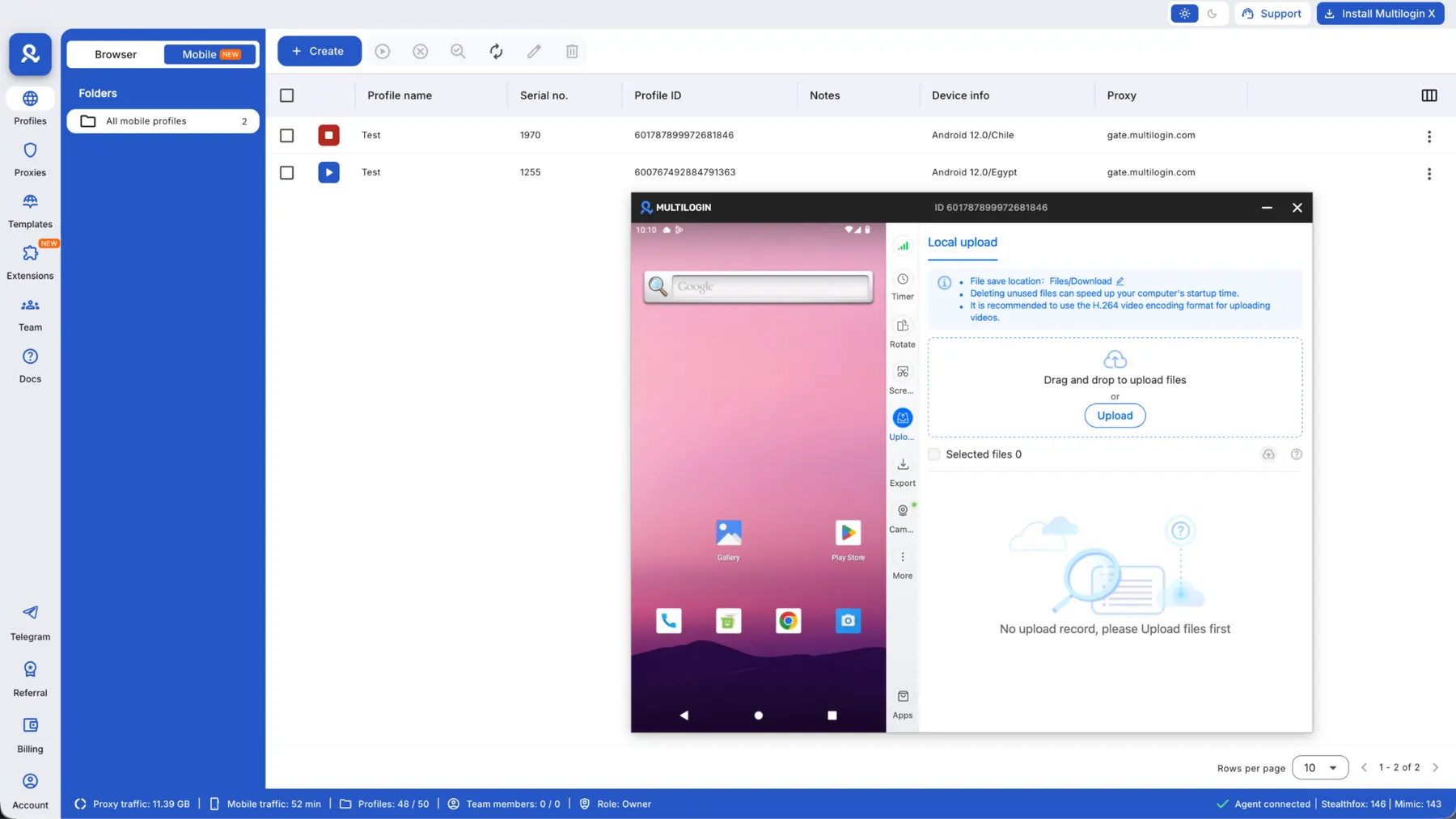
This is the feature that pulled us in, and it is genuinely different.
Plenty of tools “emulate” Android. Emulators run in a simulated shell, and mobile apps sniff them out fast, which gets accounts banned.
Multilogin runs real Android cloud phones. Actual devices hosted in the cloud, with genuine device identifiers, real IMEI, and system-level fingerprints that read as separate physical phones.
The specs that matter to us:
For anyone scaling Instagram, TikTok, or Reddit, this covers the mobile surface a desktop browser physically cannot reach.
Why Affiliate Marketers Need an Antidetect Browser
Let us make this concrete, because our readers are affiliates, not privacy hobbyists.
Ad platforms want one account per person. We want many, run cleanly, unlinked. That tension is the whole job.
Here is where a tool like Multilogin earns its keep for us.
The core promise is simple. Run dozens of accounts from one laptop and stay unlinked, without waking up to mass bans. That is the outcome we buy an antidetect browser for.
How We Used Multilogin: Our 90-Day Results
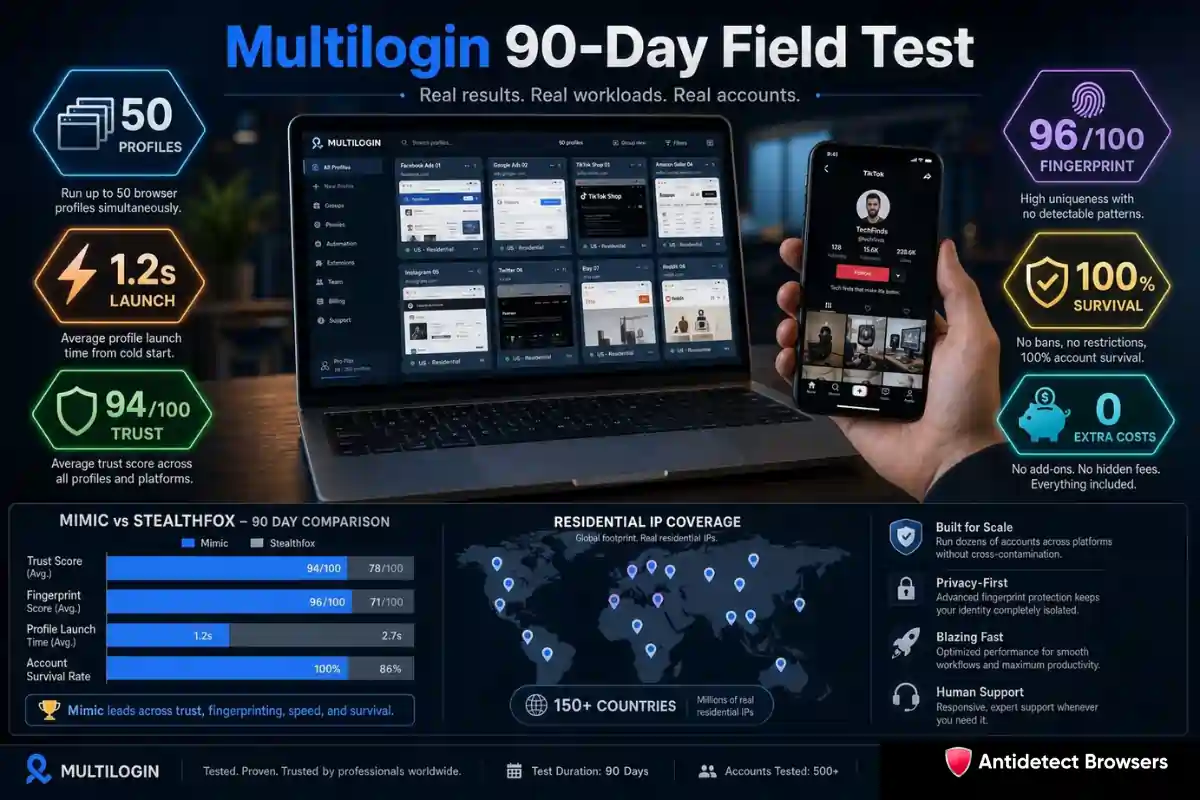
Enough theory. Everything in this Multilogin review rests on what happened when we put it to work.
We ran a 90-day stretch with 50 active profiles split across Mimic and Stealthfox, on a clean Windows 11 box with 32 GB of RAM, each profile paired to a matched residential IP.
The mix was our normal load, Facebook Ads accounts, Google Ads managers, a few Amazon seller logins and a cluster of social profiles for content pushes.
Here is how it landed:
| Metric | Our result | Context |
|---|---|---|
| Profiles run concurrently | 50 | Machine stayed usable, no freezes |
| Average launch time | 1.2 s | Mimic quicker than Stealthfox |
| CreepJS trust | 94 / 100 | Consistent across re-scans |
| Fingerprint authenticity | 96 / 100 | Highest in our current rankings |
| 30-day survival on ad platforms | 100% | Zero flags, zero checkpoints from linking |
| Proxy invoices needed | 0 extra | Included traffic covered light ad work |
The standout for us was the survival rate. Across a month of light, natural activity, not a single account got linked or flagged for association.
The only time we touched a top-up was on a heavy scraping week, when the included residential proxy traffic ran dry and we bought extra gigabytes.
On mobile, our cloud-phone TikTok profiles behaved like real handsets. The real hardware identifiers did the heavy lifting that a desktop fingerprint spoofing setup simply cannot fake.
Browser speed and profile stability in daily use
Speed is fine, not record-breaking. Octo Browser launches faster on paper, but Multilogin never made us wait.
Stability is the bigger win. Running 10 to 15 profiles at once did not drag our machine, and we saw no cookie bleed or session cross-contamination between profiles over the whole run.
One honest note. Past 40 concurrent profiles you want serious RAM, 16 GB is a floor and 32 GB is comfortable. Stealthfox specifically gets heavier under load than Mimic.
Cloud Plus Local Profile Storage (Why It Matters)
Small feature, big deal for teams.
Every profile can live in encrypted cloud storage or stay local-only on your machine, and a storage converter flips between the two.
Cloud storage means a teammate in another country opens the same profile with the same cookies and history, no credentials shared. Local storage means sensitive profiles never leave your device. Being able to choose per profile is exactly the control an agency needs.
Automation, API, and Developer Tooling
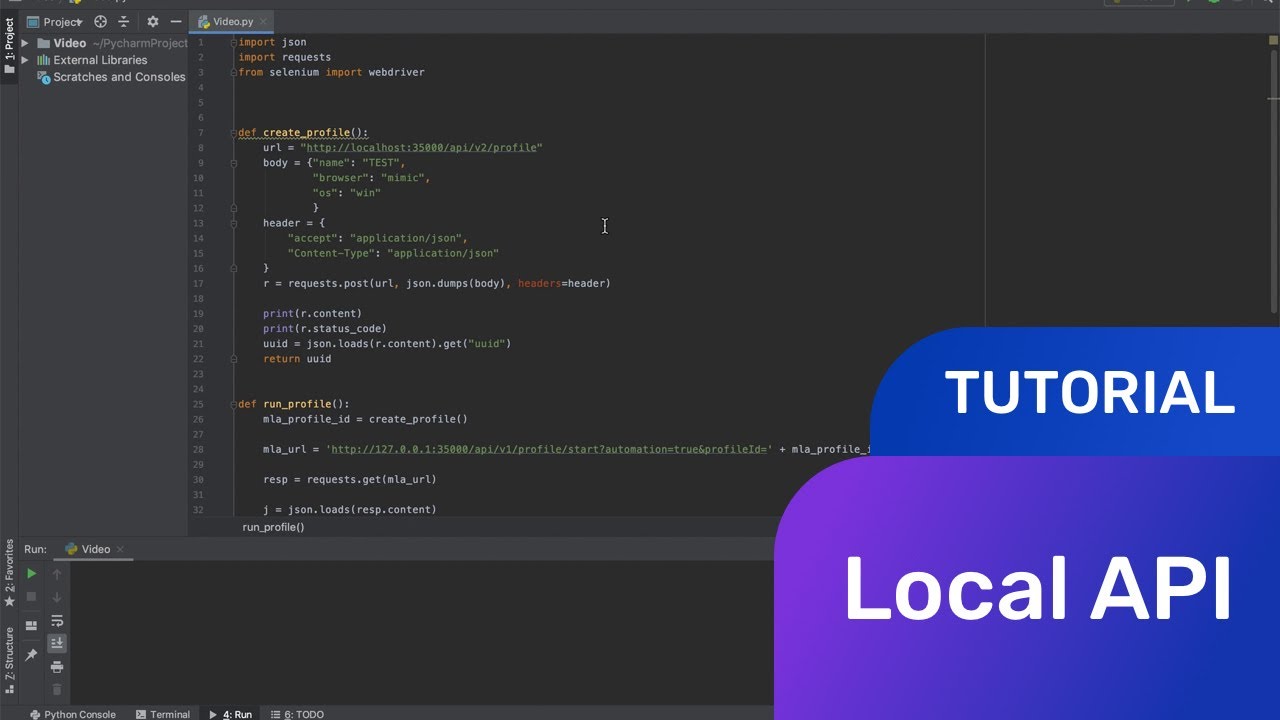
If you scale, you script. Multilogin is built for that.
It exposes a full REST API with token-based bearer auth, so you can create, launch, and kill profiles programmatically.
On top of that:
Two limits to flag honestly. Puppeteer and Playwright bind to Mimic only, and automation runs through remote WebDriver, so a local WebDriver breaks it. There is also no built-in visual RPA builder yet, which the beginner-focused rivals do offer.
API rate limits scale with your plan: 50 requests per minute on Pro 10 and Pro 50, then 100 RPM on Pro 100 and Business.
Team Seats, Security, and Compliance
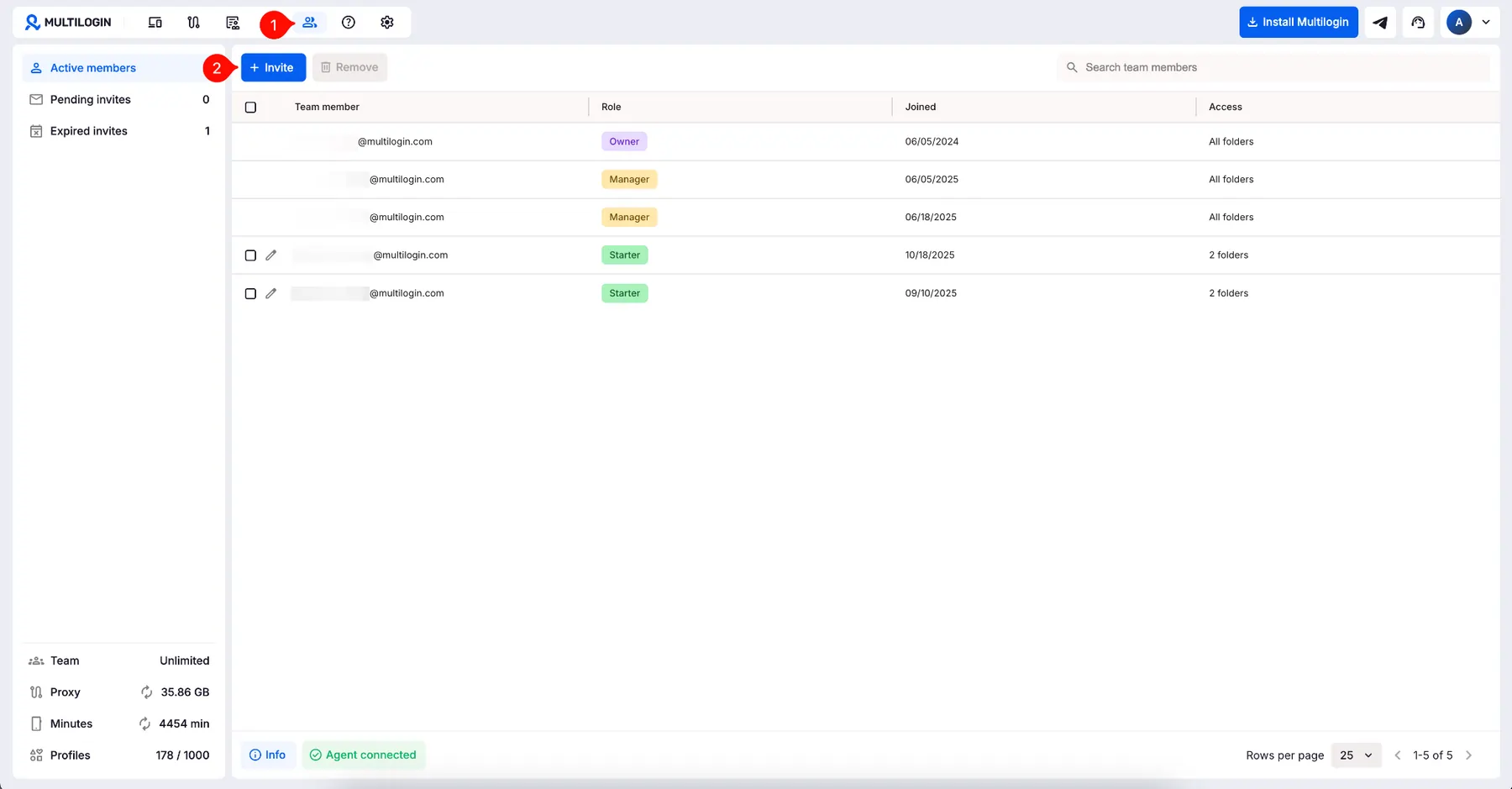
For agencies, this section decides the purchase.
Team management includes granular, role-based permissions, profile sharing and transfer without exposing passwords, plus folders, tags, and notes to keep large profile sets tidy.
On the security side:
Team seats are gated by plan. Pro 10 and Pro 50 run solo, Pro 100 adds two seats, and Business unlocks unlimited seats. If more than one person touches the accounts, Business is the realistic starting point.
Cross-Platform Support and Help
No surprises here, and that is a compliment.
Multilogin runs on Windows, macOS (including Apple Silicon), and Linux. The Apple Silicon and Linux coverage is notable, since several rivals treat Linux as an afterthought.
Support is 24/7 in-app live chat and email, in five languages (English, Vietnamese, Russian, Chinese, and Portuguese). Response times were quick whenever we pinged them.
Multilogin Pricing 2026
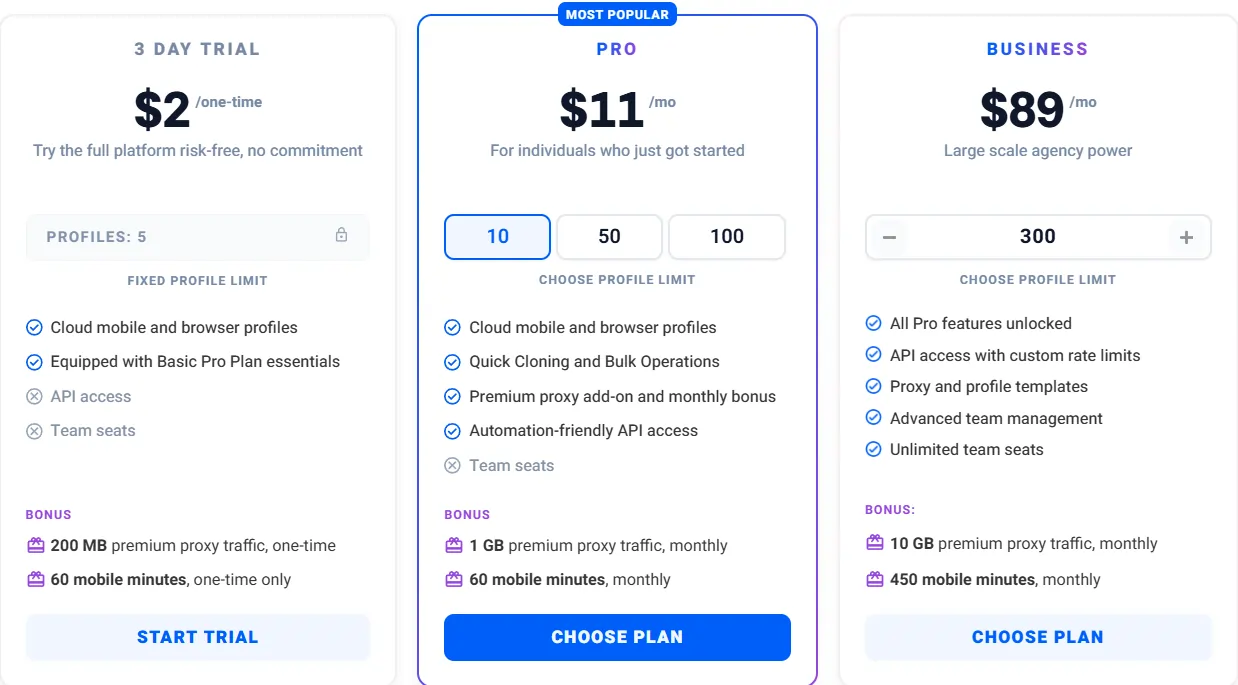
Here is the real cost, straight from current plans, no rounding games.
The model is a monthly subscription plus pay-as-you-go usage for extra proxy traffic and mobile minutes. Yearly billing cuts about 35%.
| Multilogin Plan | Monthly | Yearly (per mo / total) | Profiles | Proxy bonus | Mobile minutes | API |
|---|---|---|---|---|---|---|
| Trial | $2 one-time (3 days) | — | 5 | 200 MB one-time | 60 one-time | — |
| Pro 10 | $11 | $7.08 / $85 | 10 | 1 GB / mo | 60 / mo | 50 RPM |
| Pro 50 | $29 | $19.17 / $230 | 50 | 3 GB / mo | 75 / mo | 100 RPM |
| Pro 100 | $40 | $26.67 / $320 | 100 | 5 GB / mo | 150 / mo | 100 RPM |
| Business | from $89 | from $57.08 / $685 | 300 up to 10,000 | 10 GB+ / mo | 450+ / mo | 100 RPM |
Usage extras stack on top of the subscription, and this is where bills surprise people.
Payment covers major credit and debit cards, with VAT added in some countries. Upgrades are instant and prorated to the day, downgrades apply next cycle.
Our Honest Take on Value
Multilogin is not budget software, and it does not pretend to be.
The fair way to judge it: the subscription bundles proxies most rivals make you buy separately at $5 to $8 per GB. Fold that in and the gap narrows fast.
Still, be clear-eyed. There is no free-forever plan, only the $2 paid trial. And the usage-based proxy and minute billing means your real monthly cost floats above the sticker price. Budget for the extras or they will bite.
What We Did Not Like About Multilogin
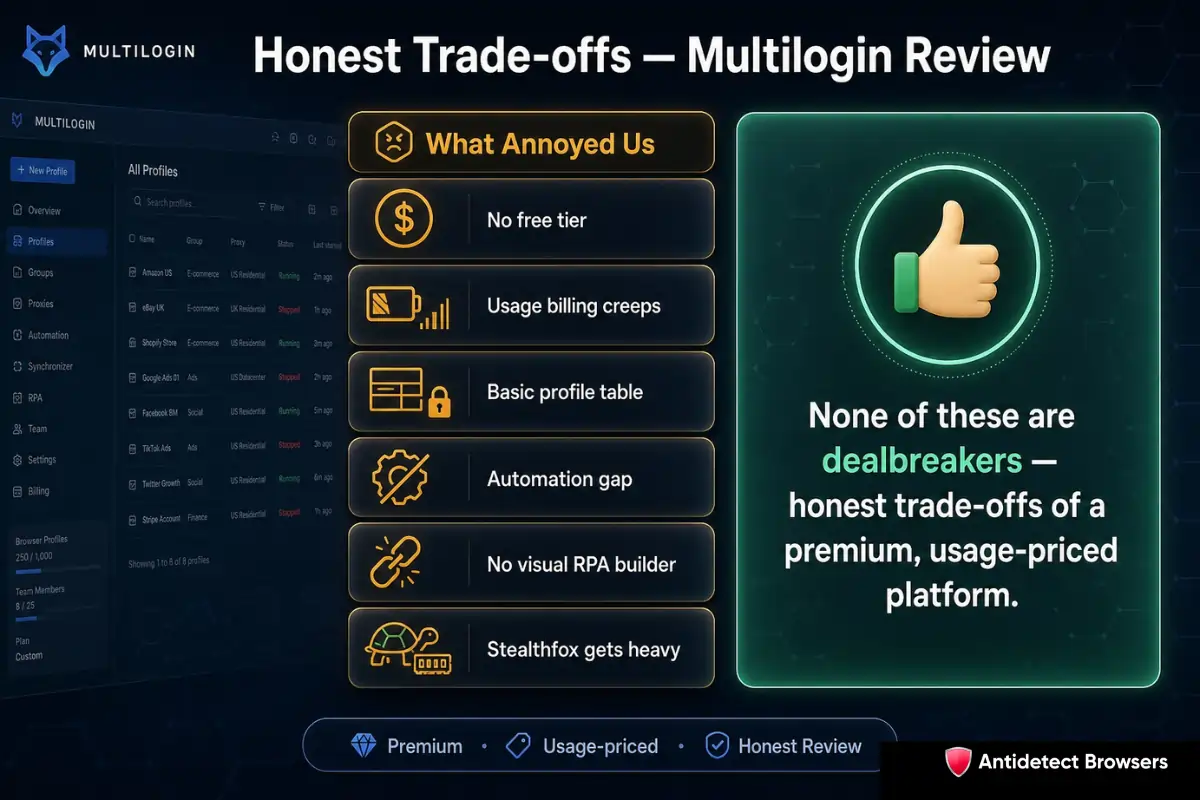
We promised honesty, so here is where Multilogin annoyed us.
None of these are dealbreakers for us. They are the honest trade-offs of a premium, usage-priced platform.
Multilogin vs Octo Browser vs Dolphin{anty} vs MoreLogin
Multilogin is not the only serious option. Here is how we frame the field after using several.
| Antidetect Browsers | Starts at (USD) | Free tier | Engines | Cloud phones | Proxies included |
|---|---|---|---|---|---|
| Multilogin | $2 trial, then $11/mo | No, $2 trial | Mimic + Stealthfox | Yes, real Android | Yes, every plan |
| Octo Browser | ≈$11/mo (3 profiles) | No trial | Octium (Chromium) | No | No |
| Dolphin{anty} | Free, paid ≈$10/mo (20) | Yes, 10 profiles | Chromium, real device prints | No | No |
| MoreLogin | ≈$9/mo | Limited free | Chromium + Firefox | Yes | No |
Octo Browser
Octo is the closest rival on fingerprint quality, with a fast Octium engine that tracks Chrome releases quickly and a slick clickable profile table.
Where it loses to Multilogin: no cloud phones, no built-in proxies, no free trial, and a support community that leans Russian-first. Great for desktop-only teams, thinner for mobile.
Dolphin{anty}
Dolphin is the budget affiliate favourite. A genuine free 10-profile tier and a visual Scenarios automation builder make it the easiest on-ramp for Facebook and TikTok ad routines.
Trade-offs: it uses real device prints but has no mobile cloud phones, its data security had past scrutiny, and it is built around the CIS market. Fine for starting out, less so for high-stakes accounts.
MoreLogin
MoreLogin is the value play. Cheap, covers browser plus cloud phones, and handles standard fingerprint spoofing well enough for everyday jobs.
The compromises show in polish, English documentation, and long-run reliability. If price beats everything, it competes. If a ban costs you real money, it does not.
Our Read
For a plain desktop team chasing fingerprint quality, Octo is a fair shout. For a broke solo affiliate, Dolphin's free tier wins. For rock-bottom budgets, MoreLogin.
But if you need a browser and real mobile devices, proxies included, and fingerprints that hold on the strict platforms, Multilogin is the one we keep paying for.
FAQs About Multilogin
Does Multilogin actually pass fingerprint checkers like Pixelscan, CreepJS, and iphey?
In our runs, fresh profiles returned consistent, human-like values across public checkers, because the fingerprints are built from real-user data instead of blanked or randomised. No tool is a magic shield, though. A perfect fingerprint still gets flagged if you pair it with a burnt proxy or aggressive behaviour, so treat the browser as one layer, not the whole defence.
Can I run Google Ads and Facebook Ads on Multilogin without accounts getting linked?
Yes, that is the core use case. Each ad account gets an isolated profile with its own fingerprint plus a matching residential IP, which stops platforms from tying accounts together through shared device or network signals. The discipline that matters is one account to one profile to one clean IP, kept consistent over time.
Can I use my own proxies instead of the built-in ones in Mutilogin?
You can. Proxy Hub accepts third-party HTTP, HTTPS, and SOCKS5 proxies, verifies them, and saves reusable proxy templates. Plenty of teams mix their own residential pool with Multilogin's included IPs, so you are never locked into one source.
Are the cloud phones real devices or emulators, and do they help on TikTok and Instagram?
They are real Android cloud phones with genuine device identifiers and real IMEI, not emulators running in a simulated shell. That distinction matters because mobile apps detect emulators and ban them, while real devices read as authentic hardware. For mobile-first platforms like TikTok, Instagram, and Reddit, that is the surface a desktop browser cannot cover.
Does Multilogin support headless runs, Docker, and scripted automation?
Yes. It offers a REST API with token-based auth, plus Selenium, Puppeteer, and Playwright with example scripts and a Postman collection. Headless mode and Docker are supported for server-side runs, and CLI control handles chained tasks. Note that Puppeteer and Playwright bind to Mimic only, and automation runs through remote WebDriver.
Cloud storage or local storage for profiles, which is safer?
It depends on your setup. Cloud storage is encrypted and lets teammates open the same profile from anywhere without sharing logins, which is ideal for agencies. Local-only storage keeps sensitive profiles on your own machine so nothing leaves your device. Multilogin lets you choose per profile and convert between the two, so you can keep client work in the cloud and your riskiest accounts local.
Final Verdict on Multilogin
After 90 days and 50 profiles, our call is simple. Multilogin is the most complete antidetect browser for affiliates and agencies in 2026.
The dual engines, the real-user browser fingerprinting, the bundled residential proxies and the genuine cloud phones add up to a stack no single rival matches in full.
It is not flawless. The usage billing wants discipline and there is no free tier. But the account survival, the fingerprint quality and the fair 2026 pricing put it back on top of our rankings.
If you want to try it, use code BROWSER50 for 50% off your first billing, with backup code AFF5025 if the first hits its cap.